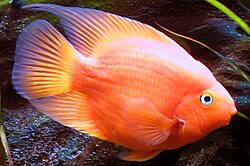
Pale color in a Blood Parrot Cichlid is one of the most common complaints in the hobby, and in most tanks a fish that is losing color is not fighting an infection at all. This fish is a man-made hybrid — usually Amphilophus citrinellus crossed with Paraneetroplus synspilus[1] — and its orange is built from carotenoid pigments that fish cannot manufacture for themselves.
They can only deposit what arrives in the food, which is why a feeding trial on this exact hybrid was able to raise or lower skin redness simply by changing dietary canthaxanthin.[2] That single fact explains most cases of a blood parrot turning pale, washed out or patchy white. The remainder are stress responses, a normal juvenile color phase, artificial dye wearing off, or genuine disease — and the way to tell them apart is the speed of the change and what else the fish is doing. Test the water first, look at the fish's age and food second, and reach for medication last.[8]
Common Causes of Pale or Faded Color in Blood Parrot Cichlid
Poor Diet
Most LikelyThis is the first thing to check in a fish that has faded slowly and evenly while behaving normally. Fish do not synthesise carotenoids de novo; the red and orange pigments in skin are dietary in origin and must be supplied and then deposited in the tissue.[3] Work on blood parrot cichlids specifically found that dietary canthaxanthin increased skin carotenoid concentration and redness in a dose-dependent way[2], which is the clearest possible demonstration that this color is a nutritional output rather than a fixed trait. In practice the failure is rarely starvation — it is a pellet with no meaningful carotenoid source, or, more often, a tub of good food that has been open for a year. Carotenoids oxidise in warm, bright, repeatedly opened containers, so a fish can lose color on exactly the same brand it has eaten since it was bought.
Fading from this cause develops over weeks to months, affects the whole body evenly, and comes back on the same timescale once the diet is corrected.
Stress
Most LikelyStress is the usual answer when the color changed fast. Teleost fish adjust skin tone through melanophores under neural and hormonal control via the melanocortin system, which disperses or aggregates pigment within minutes to hours[5], and over longer periods background color and chronic stress measurably alter both pigmentation and stress physiology.[6] A blood parrot turning white overnight, going blotchy, or showing pale patches with dark stress bars has almost always been frightened, bullied, moved, or startled by a change in lighting or tank mates.
Blood parrots are unusually vulnerable here: their hybrid mouth cannot close properly, which makes them slow feeders that lose direct competition, and a subordinate fish in a crowded tank stays pale for as long as it has nowhere to retreat to. The tell is reversibility — remove the stressor and color typically lifts within hours to days. Left in place, chronic stress also suppresses immune function through sustained cortisol elevation[7], which is how a husbandry problem eventually becomes a disease problem.
Disease
PossibleDisease is worth ruling out but is rarely the answer when pallor is the only sign. Illness that pales a fish almost always brings companions: white specks and flashing with ich, eroded or reddened fin margins and ulcers with bacterial infection, laboured breathing, stringy white faeces, bloating, or a fish that stops eating.[9][10]
One pattern deserves separate mention because owners often mistake it for simple fading: head and lateral line erosion, in which pigment is lost specifically along the lateral line and around the head, sometimes with visible pitting. A veterinary review of lateral line depigmentation in marine and freshwater fish sets out how variable and multifactorial this presentation is[11], and it is not fixed by color food. If several fish in the tank change at once, a shared cause such as water quality or a recent introduction moves to the top of the list. Confirmation of a parasite or bacterial cause requires microscopy of a skin scrape or gill biopsy, never appearance alone.[9]
Age
Less CommonAge moves color in both directions, and the direction is diagnostic. Juvenile blood parrots typically start out grey, brown or blotchy and develop adult orange over their first several months; research on juvenile blood parrot cichlid hybrids traces this divergence to differential expression of melanin-pathway genes.[4] A young fish that looks washed out is very often simply not finished, and no amount of color food will accelerate it beyond its own schedule. At the other end, a genuinely old fish may lose some intensity, but that fading is slow, symmetrical, measured in months to years, and accompanied by completely normal appetite and behaviour. The practical rule: if you can date the change to within a few weeks, it is not age. Owners frequently misattribute a fast fade to ageing and delay looking for the stressor or dietary gap that actually caused it.
Genetic Factors
Less CommonBecause the blood parrot is a hybrid rather than a natural species[1], its coloring is genuinely variable between individuals, and some fish are simply paler than their tank mates for life. This is a stable baseline, not a change, and the distinction matters: a fish that has always been light peach is not a fish that is losing color.
The more important case in this category is artificial coloring. A proportion of blood parrots sold — often marketed as jellybean, blueberry or purple parrots — have been dyed or injected rather than bred for color, and that pigment is not biologically maintained. It wears off over weeks to months, typically unevenly and often leaving the fish's true pale cream or peach body underneath. If a strikingly colored fish has faded steadily since purchase and no diet or husbandry change explains it, dye loss is a likely answer, the underlying fish is healthy, and no treatment will restore the original appearance.
How to Diagnose Pale Color in a Blood Parrot Cichlid
Work through these in order and stop when the picture fits. The aim is to place the fading on a timeline and decide whether it is dietary, behavioural or clinical before anything is added to the water.
-
Date the change and photograph the fish
Establish when the color was last normal, because with a blood parrot losing color the speed of the change separates the causes far more reliably than appearance does. A change over hours to days points to stress; over weeks to months points to diet, dye loss or a slow disease process; over many months in an otherwise healthy adult may be age. Photograph both flanks under the same light, ideally against the same background, and repeat every three to five days — memory is unreliable for gradual color change, and a photo series settles whether the fish is still fading, holding steady or recovering. Note the pattern too: even overall pallor, blotches, pale patches with dark bars, or loss concentrated around the head and lateral line each point somewhere different.
-
Test ammonia, nitrite, nitrate, pH and temperature
Do this before considering any medication; water analysis together with a full history is the recommended starting point of a fish workup.[8] In an established aquarium ammonia and nitrite should read zero, and any detectable reading points to an immature or overloaded biofilter that needs a prompt water change and reduced feeding.[12] Confirm temperature sits in the 24–28°C band this hybrid prefers, since a blood parrot held persistently cool often looks dull and sluggish and colors up again on correction. Read the result honestly in both directions: bad water explains stress and pallor, but clean water rules out a major cause and tells you to stop doing water changes and look at the food and the social situation instead.
Recommended: Water test kit -
Audit the food, including how old it is
Read the ingredient panel rather than the marketing on the front. A staple that will maintain this fish's color lists a real carotenoid source — astaxanthin, canthaxanthin, krill, shrimp or spirulina — near the front, because skin redness in blood parrot cichlids tracks dietary carotenoid intake directly.[2][3] Then check the date the tub was opened. Carotenoids degrade with exposure to air, heat and light, so a container open for six months or more may be well below its labelled specification even though the food looks and smells fine. Confirm the fish is actually eating its share: a blood parrot's malformed mouth makes it a slow feeder, and in a mixed tank it can be quietly outcompeted while appearing to feed.
-
Watch the tank's social dynamics for ten minutes
Color driven by stress is a behavioural sign, so it has to be diagnosed behaviourally. Sit and watch without feeding: note whether the fish holds an open position or hugs a corner, whether another fish drives it off the food or away from a favoured spot, and whether its pallor deepens when a particular tank mate approaches and lifts when that fish moves away. Chronic social stress alters pigmentation and stress physiology measurably[6], and a fish that pales on approach and recolors within minutes has effectively diagnosed itself. Also account for non-social stressors: a recent move, new substrate or background, harsh unshaded lighting, or heavy traffic past the tank.
-
Examine for disease signs, and escalate to microscopy if present
Check the whole fish under strong light for white specks, flashing or rubbing, eroded or reddened fin margins, ulcers, excess mucus, pitting along the head and lateral line, laboured gill movement, bloating or abnormal faeces.[9][10][11] Inspect every other fish in the tank under the same light, since a shared change points to a shared cause. If the fish is pale but eating well, breathing normally and has intact fins, this step is negative and you should return to diet and stress. If it is positive, identification requires tissue rather than appearance: a skin scrape, fin clip and gill wet mount examined under a microscope, which is a job for an aquatic veterinarian.[9]
Recommended: Aquatic veterinarian
How to Restore a Blood Parrot Cichlid's Color
-
Correct water quality first, whatever the diagnosis
This is husbandry and it comes before everything else. If ammonia or nitrite is detectable, change water promptly, cut feeding and reassess the biofilter rather than dosing the tank.[12] Dechlorinate and temperature-match replacement water, and do not strip or replace filter media, which sets the biological filter back and prolongs the problem. Bring temperature into the 24–28°C range and hold it steady instead of chasing an ideal number. Correcting water quality is not a treatment for a nutritional deficit or a dye that has worn off, but it removes the most common driver of stress and secondary infection, and in a fair number of cases the color returns with no other intervention at all.
-
Switch to a fresh, carotenoid-rich staple
This is the single highest-yield fix for a blood parrot that has faded gradually. Move to a cichlid pellet that names astaxanthin, canthaxanthin, krill, shrimp or spirulina near the front of the ingredient list, and rotate it with frozen krill or mysis rather than relying on one product.[2][3] Buy the smallest tub you will finish in about two months and keep it sealed, cool and out of direct light so the carotenoids do not oxidise before they are eaten. Feed modest amounts the fish will clear, since surplus food loads the filter and undoes step one. Do not overdose color enhancers hoping to speed things up: deposition is gradual, and expect visible improvement over three to six weeks rather than days.
-
Remove the stressor and give the fish cover
If step four of the diagnosis identified a social or environmental stressor, act on it directly. Add caves, pipework and planting to break sightlines so a subordinate fish has somewhere to be out of view; rearranging the layout also resets established territories. Rehome or separate a tank mate that is persistently driving the fish, and reconsider stocking density — blood parrots are large-bodied and slow, and a tank that looked adequate for juveniles often is not. Soften harsh lighting and minimise netting and handling. Chronic stress suppresses immune function through sustained cortisol elevation[7], so this step protects against the next problem as much as it fixes this one. Stress pallor usually lifts within hours to days once the cause is genuinely gone.
-
Treat disease only once it is identified
Medicate for a condition you have found, never for color alone. Dosing an aquarium on suspicion stresses an already stressed fish, can damage the biofilter, and buries the evidence you need to work out what is actually wrong. If microscopy confirms a parasite, treatment targets the free-living stages of that specific organism[9]; where bacterial disease is confirmed, drug selection should rest on sensitivity testing wherever that is available rather than on appearance.[10] Lateral line depigmentation is multifactorial and is managed by correcting water quality, diet and husbandry rather than by a single medication.[11] If the fish is pale with no other clinical sign, the correct treatment is no treatment.
-
Track recovery on the right timescale
Different causes resolve at different speeds, and knowing which you are watching prevents pointless intervention. Stress pallor lifts in hours to days. Dietary recovery is measured in weeks — pigment has to be eaten, absorbed and deposited, so three to six weeks is a realistic window before the change is obvious in a photograph. A juvenile coloring up follows its own developmental schedule over months.[4] Dye loss never reverses. Keep photographing both flanks under identical lighting and log water tests alongside, and judge progress primarily by appetite, respiration, fin condition and confidence rather than by color, which is the slowest thing to move. Escalate if the fish stops eating, breathes hard, develops ulcers or deteriorates.
Preventing Pale Color in Blood Parrot Cichlids
When a Pale Blood Parrot Cichlid Needs Expert Help
🔬 AI Symptom Checker
Not sure what's wrong? Describe your fish's symptoms to the FishCare AI and get an instant diagnosis.
Check Symptoms →Frequently Asked Questions
Can poor water quality cause my Blood Parrot Cichlid to lose color?
What type of food should I feed my Blood Parrot Cichlid to enhance color?
Is it normal for my Blood Parrot Cichlid to have a lighter color as it ages?
How can I tell if my Blood Parrot Cichlid has a disease that's causing its color loss?
Can overcrowding in the tank cause color loss in Blood Parrot Cichlids?
This guide was reviewed for biological accuracy and practical aquarium care guidance. Always test water parameters before treating a sick fish — poor water quality is the most common root cause. Consult an aquatic veterinarian if symptoms persist after 48 hours of correct treatment.
References
- Aqmal-Naser, M. & Ahmad, A. (2020). First report of the hybrid blood parrot cichlid from a rice agroecosystem in Seberang Perai Tengah, Penang, Peninsular Malaysia, with notes on syntopic Midas cichlid, Amphilophus citrinellus (Günther, 1864). BioInvasions Records 9(3). doi:10.3391/bir.2020.9.3.15
- Li, M., Rahman, M.M., Wu, B. et al. (2016). Effects of dietary canthaxanthin on growth and body colour of blood parrot cichlid Amphilophus citrinellus × Paraneetroplus synspilus. Aquaculture International 25. doi:10.1007/s10499-016-0068-z
- Pailan, G., Sahoo, S. & Singh, D. (2019). Role of Carotenoids in Ornamental Fish Nutrition: A Review. Indian Journal of Animal Nutrition 36(3). doi:10.5958/2231-6744.2019.00037.9
- Li, C., Zhang, X., Meng, Y. et al. (2025). Melanin pathway genes drive skin color divergence in juvenile blood parrot cichlid hybrids. Academia Molecular Biology and Genomics 2. doi:10.20935/acadmolbiogen7803
- Cal, L., Suarez-Bregua, P., Cerdá-Reverter, J.M. et al. (2017). Fish pigmentation and the melanocortin system. Comparative Biochemistry and Physiology Part A 211: 26–33. doi:10.1016/j.cbpa.2017.06.001
- van der Salm, A.L., Spanings, F.A.T., Gresnigt, R. et al. (2005). Background adaptation and water acidification affect pigmentation and stress physiology of tilapia, Oreochromis mossambicus. General and Comparative Endocrinology 144(1): 51–59. doi:10.1016/j.ygcen.2005.04.017
- Tort, L. (2011). Stress and immune modulation in fish. Developmental and Comparative Immunology 35(12): 1366–1375. doi:10.1016/j.dci.2011.07.002
- Merck Veterinary Manual. Management of Aquarium Fish. Merck & Co., Inc. merckvetmanual.com
- Merck Veterinary Manual. Parasitic Diseases of Fish. Merck & Co., Inc. merckvetmanual.com
- Merck Veterinary Manual. Bacterial Diseases of Fish. Merck & Co., Inc. merckvetmanual.com
- Dannemiller, N.G., O'Connor, M.R. & Van Bonn, W.G. (2021). An integrative review of lateral line depigmentation in marine and freshwater fish. Journal of the American Veterinary Medical Association 259(6): 617–625. doi:10.2460/javma.259.6.617
- Yanong, R.P.E. Fish Health Management Considerations in Recirculating Aquaculture Systems — Part 1: Introduction and General Principles. UF/IFAS Extension, Circular 120. edis.ifas.ufl.edu