Parrot fish care in the aquarium hobby means caring for the blood parrot cichlid — the round, bright orange, permanently smiling hybrid sold in almost every fish store. This blood parrot cichlid care guide covers the tank, water, food, tank mates, colors and health of the parrot fish.
The short version: a 30-gallon-plus tank, warm stable water at 76–84°F, sinking food its deformed mouth can actually eat, calm tank mates, and an eye on the health problems that come with a hybrid body. If you were looking for the beaked reef grazer, that is the marine parrotfish (family Scaridae) — a different animal, covered on the types and colors page.
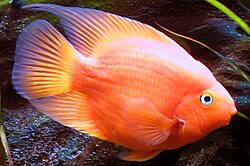
What Is a Blood Parrot Fish?
The blood parrot cichlid is a man-made hybrid, first bred in Taiwan around 1986. It has no scientific name and no wild population, because it does not exist in nature. The parent species are generally accepted to be the midas cichlid (Amphilophus citrinellus) crossed with the redhead cichlid (Paraneetroplus synspilus), though breeders have never published the exact line (see the blood parrot cichlid entry on Wikipedia for the competing theories).
The hybrid inherited a set of physical quirks that define how you have to keep it:
- A deformed mouth that only opens into a narrow vertical slit and cannot fully close. Parrot fish cannot bite, tear or chase food properly — they suck it in from close range.
- A compressed body and shortened spine, which makes them slow, wobbly swimmers that lose races to the food.
- A reduced swim bladder cavity in some individuals, making them prone to buoyancy problems if overfed.
- Male sterility. Almost all male blood parrots are infertile, so pairs lay eggs that never hatch. See breeding blood parrot fish.
None of that makes blood parrot cichlid care hard. It makes them a fish with specific requirements — sinking food, gentle tank mates, and enough space — and a personality that most cichlid keepers rate as the friendliest in the family.
Parrot Fish Care at a Glance (Blood Parrot Cichlid)
| Care factor | Requirement |
|---|---|
| Adult size | 7–8 inches (18–20 cm), occasionally 10 inches |
| Lifespan | 10–15 years, up to 20 in good conditions |
| Minimum tank | 30 gallons for one; 55–75 gallons for a pair |
| Temperature | 76–84°F (24–29°C) |
| pH | 6.5–7.4 |
| Hardness | 6–18 dGH |
| Ammonia / nitrite | 0 ppm always |
| Nitrate | Under 30 ppm |
| Diet | Omnivore — sinking cichlid pellets, frozen foods, vegetables |
| Temperament | Semi-aggressive but timid; territorial at spawning time |
| Care level | Beginner to intermediate |
Parrot Fish Tank Size and Setup
The first rule of parrot fish care is tank length. A single blood parrot cichlid needs 30 gallons minimum, a pair needs 55–75 gallons, and a small group needs 100 gallons or more. They are wide-bodied fish that grow to 8 inches and produce a heavy waste load, so a long tank beats a tall one every time.
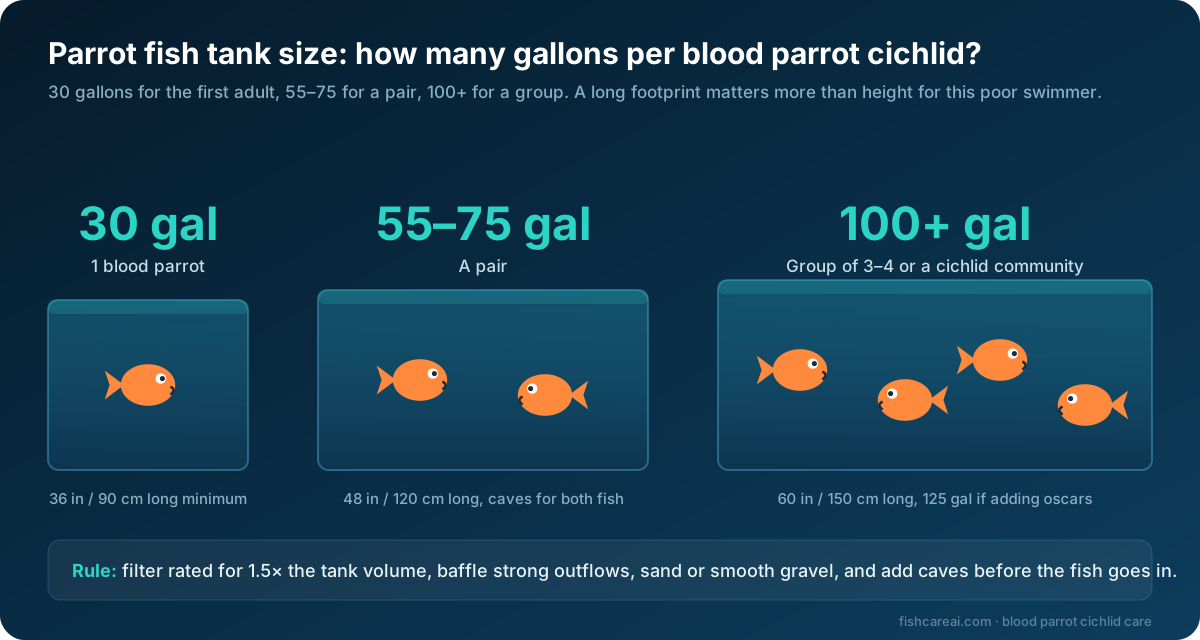
Set the tank up around their weaknesses: soft sand or smooth rounded gravel (they dig), plenty of caves and driftwood for hiding, and moderate flow — a poor swimmer pinned against the outflow of an oversized powerhead is a stressed fish. Filtration should be rated for at least 1.5× the tank volume, with the return baffled if it is strong. Full detail is on the parrot fish tank size guide.
Parrot Fish Water Parameters and Temperature
Blood parrot cichlids want warm, stable, clean water: 76–84°F (24–29°C), pH 6.5–7.4, and nitrate under 30 ppm. They tolerate a wide pH range, but they do not tolerate swings — a stable 7.6 is better than a pH you keep chasing back to 7.0 with chemicals.
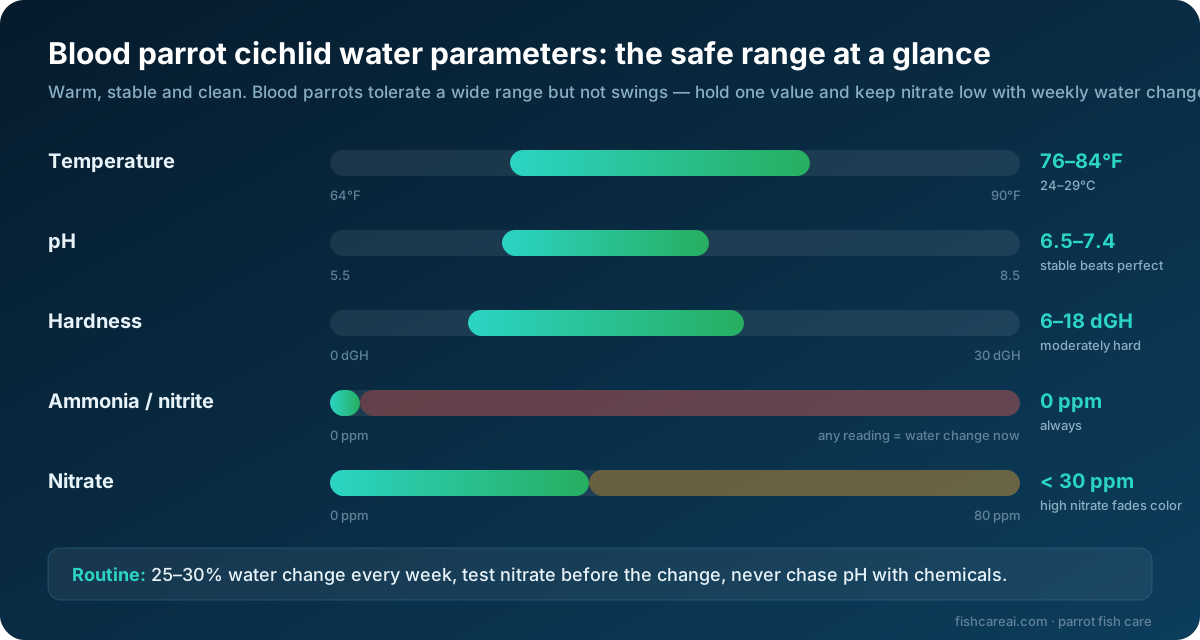
Change 25–30% of the water weekly. Their appetite and waste output are high for their size, and nitrate creep is the most common reason a parrot fish loses color. See parrot fish temperature and water parameters.
Parrot Fish Food and Feeding
Feeding is where blood parrot cichlid care differs most from other cichlids. Feed sinking pellets sized for the mouth — that mouth cannot chase floating food across the surface, and a parrot fish gulping air at the top is a buoyancy problem waiting to happen. A good weekly rotation:
- Staple: sinking cichlid pellets with astaxanthin and spirulina for color, twice a day, as much as they finish in 2 minutes.
- Protein: frozen bloodworms, brine shrimp or mysis 2–3 times a week.
- Vegetable: blanched peas (also the fix for constipation), spirulina flake or zucchini once a week.
- Fast: one no-food day per week keeps the gut working and blood parrots very rarely need more food than that.
Full feeding schedule and color-food comparison: best food for parrot fish.
Parrot Fish Tank Mates
Blood parrot cichlids are the contradiction of the cichlid world — territorial enough to chase, too timid and too badly built to fight well. The best tank mates are calm fish of similar size that are neither aggressive nor bite-sized: severums, silver dollars, larger tetras such as Congo tetras, giant danios, bristlenose plecos and corydoras.
Avoid neon tetras and other small fish (they get eaten), tiger barbs and serpae tetras (they nip the slow-moving fins), and genuinely aggressive cichlids such as red devils, jaguars and Jack Dempseys. Oscars are the popular question — possible in 125 gallons or more, risky below that, and covered on the parrot fish tank mates page.
Parrot Fish Colors, Types and Dyed Fish
Blood parrots hatch brown-grey and turn orange at around 5–6 months. Natural colors are orange, red, yellow and occasionally a calico-style mix. There is no naturally blue, purple or green blood parrot.
See types of parrot fish and colors for the hybrid varieties (king kong, red mammon, short-body, heart parrot) and the marine parrotfish species.
Common Parrot Fish Health Problems
Most parrot fish care problems are not diseases at all — they are the hybrid body reacting to overfeeding, stale water or stress. Work through these in order before reaching for medication:
- Faded or washed-out color — almost always stress, poor diet, or nitrate build-up rather than disease.
- Black spots or black patches — usually healing ammonia burn or stress marbling, not an infection. Diagnostic walkthrough: parrot fish black spots.
- Swim bladder / buoyancy trouble — overfeeding or gulped air. Fast 2 days, then feed blanched peas.
- Ich (white spot) — white grains like salt; raise temperature to 82°F and treat.
- Hole-in-the-head (HLLE) — pitting above the eyes, linked to poor diet and stale nitrate-heavy water.
Species-specific disease detail: blood parrot cichlid diseases.
Parrot Fish Lifespan and Size
A well-kept blood parrot lives 10–15 years and reaches 7–8 inches, with growth largely finished by year three. Fish kept in undersized tanks and fed a flake-only diet commonly die at 3–5 years, which is why the "5 year lifespan" figure circulates. See parrot fish lifespan and how big parrot fish get.
The Hybrid Question: Should You Keep a Parrot Fish?
Blood parrot cichlids are controversial. Their deformities are the direct result of selective hybrid breeding, and some countries and retailers refuse to stock them (Aquarium Co-Op's blood parrot care guide makes the case for keeping them well rather than not at all). That is a fair debate to have before you buy. What is not debatable is the standard once you own one: a fish with a mouth that barely works and a spine that limits its swimming deserves an appropriately sized tank, sinking food it can actually eat, and tank mates that will not outcompete or bully it.
Parrot Fish Care FAQ
What is a blood parrot fish?
The blood parrot cichlid is a man-made hybrid first bred in Taiwan around 1986, generally accepted to be a cross between the midas cichlid and the redhead cichlid. It has no scientific name and no wild population, and it inherited a deformed mouth that cannot fully close plus a compressed spine.
How big do parrot fish get?
Blood parrot cichlids reach 7-8 inches (18-20 cm) at adult size, with exceptional fish hitting 10 inches. Most growth happens in the first 18 months and is essentially finished by year three.
How long do parrot fish live?
A well-kept blood parrot fish lives 10-15 years, and 20 years is possible. Fish kept in tanks under 30 gallons or fed a flake-only diet commonly die at 3-5 years.
What size tank does a parrot fish need?
Thirty gallons is the minimum for a single blood parrot, 55-75 gallons suits a pair, and 100 gallons or more is needed for a group or a mixed cichlid community. Length matters more than height for these poor swimmers.
Are blood parrot fish aggressive?
They are semi-aggressive but unusually timid for cichlids. They will claim a cave and chase intruders away from it, particularly when spawning, but their deformed mouth means they rarely do real damage and they are frequently bullied by more capable fish.
Are blue and purple parrot fish real?
No. Blood parrot cichlids are naturally orange, red, yellow or calico. Blue, purple and 'jellybean' parrots are artificially dyed, which damages the slime coat and shortens life. The blue and green parrot fish in photos are marine parrotfish from coral reefs, not aquarium fish.