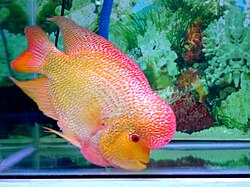
"My flowerhorn is losing colour" can mean two opposite things, and the first job is to decide which one you are seeing. In one, a fish that was grey, bronze or black is losing its dark pigment in patches and turning yellow, orange or red underneath. In the other, a fish that was bright is becoming dull, pale or muddy. The first is usually a normal developmental change; the second is usually a husbandry signal. They need completely different responses.
The flowerhorn is a man-made hybrid of Central American cichlids that reportedly include the Midas cichlid Amphilophus citrinellus, the red devil A. labiatus, Vieja melanurus and A. trimaculatus.[1] The Midas cichlid is famous among biologists for exactly the kind of fading flowerhorn keepers describe: some individuals lose their black pigment cells during life and turn gold, orange or even white.[2][3] That inheritance is the most common reason a young flowerhorn "loses colour". The sections below explain how to recognise it, and how to tell it apart from stress, colour that was boosted before sale, diet, water problems and disease.
Why Is My Flowerhorn Losing Color? The Common Causes
Natural Fading (the "Fader" Trait)
Most LikelyFlowerhorn breeders call fish that do this "faders", and golden-base lines are sold on the expectation that they will fade. The biology has been worked out in the Midas cichlid, one of the flowerhorn's reported parents.[1] Most Midas cichlids stay grey-black for life, but about one in ten lose their melanin during development and become the conspicuous "gold morph"; a study in Nature Communications traced this to a single inherited variant and described the transition starting anywhere between about three months and four years of age, then running its course within a few weeks.[2] During the change, the melanin-bearing pigment cells (melanophores) progressively die.[2] That is why fading is one-way: the black is not hiding, it is gone.
What owners see matches the research closely. Fading rarely proceeds evenly — black blotches break up, the flank marks and the dorsal fin often clear at different rates, and patches of dark can persist for a long time; in Midas cichlids dark regions sometimes remain years after the change.[3] The gold allele is dominant,[3] so faders tend to produce faders, which is why some flowerhorn lines fade reliably and others never do. The key features are that the colour underneath is bright rather than dull, and the fish keeps eating, patrolling and displaying as normal. A fading flowerhorn often looks alarming halfway through — mottled, blotchy, almost bruised — but needs no treatment at all.
Stress: Dark, Blotchy or Barred Colour
Most LikelyFish change colour physiologically as well as developmentally. The melanocortin hormone system controls how pigment is spread or concentrated inside melanophores, and its activation darkens the skin within minutes to hours.[4] Flowerhorns use this constantly: a confident fish shows clean colour, while a frightened, beaten or unsettled one goes dark, shows a row of black blotches along the side, or turns patchy and dull. Background matters too; in a controlled study on another cichlid, fish darkened to match black backgrounds and lightened on white ones, and found the black background more stressful.[5]
Stress colour appears quickly and usually has an obvious trigger: a move to a new tank, a rearranged layout, a new tank mate, a divider being removed, heavy maintenance, or people moving close to the glass. It fades just as quickly once the cause is removed, often within hours or days. If it does not, the fish is under chronic stress, which weakens the mucus and skin barrier and suppresses immune defences — how a colour problem turns into a disease problem.[6]
Colour Boosted Before Sale Wearing Off
PossibleFlowerhorns are sold on colour and head size, and a fish that looked electric in the shop and then dulled within weeks at home may have been pushed before sale. A review of artificially coloured aquarium fish describes fish being treated with hormones to intensify colour, and notes that the intense colour can last only a few weeks before the fish fades to a much paler one.[7] It also notes that colour-enhancing foods work only while they are fed: once the fish is taken off them, it eventually loses the added colour.[7]
The signature of this cause is timing. The fading starts soon after purchase, affects the whole body rather than breaking up dark patches, and is not accompanied by illness. The fish underneath is usually healthy; it is simply settling to its own natural colour. A good diet will support that natural colour, but it will not recreate a hormone-driven peak, and trying to chase it with more supplements is not worthwhile.
Diet Low in Carotenoids
PossibleThe red, orange and yellow in a flowerhorn come from carotenoid pigments, which fish obtain from food. A 90-day feeding trial on flowerhorns showed that adding carotenoid-rich ingredients — fairy-shrimp meal or spirulina — increased skin redness and chroma and raised the concentrations of canthaxanthin, astaxanthin and beta-carotene in the skin and muscle, compared with a basal diet without them.[8] The same trial shows the other side: on a diet without a good carotenoid source, the warm colours are not maintained.
Dietary fading is slow and even: over weeks to months the reds become orange and the oranges become yellow, with no change in behaviour. It is common in fish fed one cheap staple, feeder fish, or a tub of pellets that has been open for a long time. Note that diet affects the warm colours, not the black; a fish losing black pigment is fading, not underfed.
Water Quality and Temperature
PossibleFlowerhorns are big, messy eaters, often kept alone in tanks that are small for their size, and their water can deteriorate faster than owners expect. Ammonia at low concentrations causes stress and damages the gills, and fish kept in it for long periods are more susceptible to bacterial infections and grow poorly.[9] In pet aquaria, total ammonia nitrogen or nitrite are often high enough to be toxic.[10] A flowerhorn in poor water typically goes dull, clamps its fins, sulks at the back and eats less.
Temperature matters as well. The flowerhorn is a tropical fish that does best around 26–30 °C with a pH of about 7.0–7.8; a fish kept persistently cool is often sluggish and dull and brightens again when the temperature is corrected. A heater that has failed in winter is a common, easily missed cause.
Illness and Old Age
Less CommonDisease is the least common reason for colour loss when colour is the only sign, but it matters when it is present. Chronic infections such as mycobacteriosis cause emaciation, skin ulcers, bulging eyes and paleness,[11] and bacterial outbreaks in general are triggered by poor water, handling, temperature swings and other stress.[11] A sick flowerhorn does not just lose colour: it stops eating, hides, clamps its fins, breathes faster, or develops sores, cloudy eyes or a sunken belly.
Old fish can also lose some intensity. Flowerhorns can live ten years or more, and the fading of age is slow, even and measured in years rather than weeks, in a fish that is otherwise normal. If you can date a colour change to the last few weeks, it is not age.
How to Tell Why Your Flowerhorn Is Losing Colour
Work through these in order. The first two steps sort out most cases, and none of them involves adding anything to the water.
-
Decide which colour is disappearing
Look at the fish under good light. If the black is breaking up and bright yellow, orange or red is showing underneath, you are almost certainly watching a fader, especially in a fish under about two years old.[2][3] If the bright colours are becoming dull, pale or muddy, or the whole fish has turned dark, skip to step 3. A fish doing both — losing black and looking drab — may be fading and stressed at once.
-
Photograph both sides every few days
Take side-on photos under the same light and against the same background every three to five days. Fading shows as dark areas steadily shrinking and not returning.[2] Stress colour comes and goes between photos, sometimes within the same day.[4] Diet and boosted-colour loss show as a slow, even dulling across the whole body. Memory is unreliable for gradual change; a photo series settles it.
-
Link the change to recent events
Ask what changed in the week before the colour did: a new tank or background, rearranged decor, a new fish or mirror, a divider, a big water change, a heater fault, a house move. A change within hours of an event points to stress.[5][6] A slow dulling starting a few weeks after purchase points to boosted shop colour wearing off.[7]
-
Test the water and check the heater
Test ammonia, nitrite, nitrate, pH and temperature. Ammonia and nitrite should both read zero; any detectable level is a stressor that also raises the risk of bacterial disease.[9] Confirm the tank is holding 26–30 °C with a thermometer you trust, not just the heater dial. A water sample and a clear history are also what an aquatic vet will ask for first.[10]
Recommended: Water test kit -
Read the food label and the opening date
A staple that maintains red and orange lists a real carotenoid source — krill, shrimp, spirulina, astaxanthin or canthaxanthin — rather than relying on added colourants.[8] Check how long the tub has been open, and whether the fish is fed mostly feeders or a single cheap pellet.
-
Look for signs of illness
Check for clamped fins, faster breathing, sores, frayed fins, white spots, cloudy or bulging eyes, a thin back or sunken belly, stringy white faeces and refusal to eat. Any of these moves disease up the list; colour loss alone, in a fish that eats and displays normally, usually does not.[11]
What to Do When a Flowerhorn Is Losing Colour
-
If it is fading: leave it alone
Fading needs no treatment and cannot be reversed or stopped; the pigment cells are lost as part of normal development.[2] Keep water and diet good so the colour underneath comes through at its best, and expect an untidy, blotchy stage that may last weeks or longer before the fish settles. Some dark patches may never clear completely.[3]
-
If it is stress: remove the trigger
Put the tank somewhere with less traffic, reduce sudden lighting changes, stop rearranging the layout, and remove or separate any tank mate the flowerhorn is fighting with. Avoid very dark backgrounds, which in research on another cichlid were more stressful than light ones.[5] Stress colour usually clears within days once the cause is really gone; if it does not, look for a stressor you have missed, starting with water quality.[6]
-
Correct the water and temperature
If ammonia or nitrite is detectable, do a partial water change with dechlorinated, temperature-matched water, cut feeding, and check that the filter is sized for a large, heavily fed cichlid. Do not wash all the filter media at once. Bring the temperature back into the 26–30 °C range and keep it stable. Good water is also the main defence against the bacterial infections that follow chronic stress.[9][11]
-
Upgrade the diet and be patient
Use a quality cichlid pellet with a named carotenoid source as the staple and add frozen krill or shrimp a few times a week. In the flowerhorn feeding trial, colour improvements were measured over 30 to 90 days, not days,[8] so allow at least a month before judging. Buy food in sizes you will use within a couple of months and keep it sealed and cool. A diet will restore the fish's own colour; it will not bring back colour that came from hormones or a shop's colour food.[7]
-
If there are other symptoms: isolate and get a diagnosis
A flowerhorn that is losing colour and has stopped eating, has sores, cloudy eyes or clamped fins needs more than a diet change. Correct the water first, then contact an aquatic veterinarian: bacterial infections need to be identified, and antibiotics chosen on the basis of culture and sensitivity testing rather than guesswork.[11] Do not dose general-purpose medicines for colour loss alone.
Keeping a Flowerhorn's Colour
When Colour Loss Needs Expert Help
🔬 AI Symptom Checker
Not sure what's wrong? Describe your fish's symptoms to the FishCare AI symptom checker for a second opinion before you treat.
Check Symptoms →Frequently Asked Questions
Why is my flowerhorn losing its black markings?
At what age do flowerhorns fade?
Why did my flowerhorn turn black?
My flowerhorn looked amazing in the store but lost colour at home. Why?
Can I stop my flowerhorn from fading?
Is my flowerhorn losing colour because it is sick?
This guide was researched against the veterinary and scientific sources listed below and reviewed for biological accuracy. Test water parameters before treating a sick fish, and consult an aquatic veterinarian if symptoms persist after 48 hours of correct treatment.
References
- Sari, D.W.K., Achmad, H., Rahman, H. & Bimasuci, H. (2023). Molecular Identification of Several Morphologically Distinct Flowerhorn Fish (Family) Using Mitochondrial COI Gene Marker. Journal of Tropical Biodiversity and Biotechnology 8(2): 78459. doi:10.22146/jtbb.78459
- Kratochwil, C.F., Kautt, A.F., Nater, A., Härer, A., Liang, Y., Henning, F. & Meyer, A. (2022). An intronic transposon insertion associates with a trans-species color polymorphism in Midas cichlid fishes. Nature Communications 13: 296. doi:10.1038/s41467-021-27685-8
- Henning, F., Jones, J.C., Franchini, P. & Meyer, A. (2013). Transcriptomics of morphological color change in polychromatic Midas cichlids. BMC Genomics 14: 171. doi:10.1186/1471-2164-14-171
- Cal, L., Suarez-Bregua, P., Cerdá-Reverter, J.M., Braasch, I. & Rotllant, J. (2017). Fish pigmentation and the melanocortin system. Comparative Biochemistry and Physiology Part A 211: 26–33. doi:10.1016/j.cbpa.2017.06.001
- van der Salm, A.L., Spanings, F.A.T., Gresnigt, R., Wendelaar Bonga, S.E. & Flik, G. (2005). Background adaptation and water acidification affect pigmentation and stress physiology of tilapia, Oreochromis mossambicus. General and Comparative Endocrinology 144(1): 51–59. doi:10.1016/j.ygcen.2005.04.017
- Francis-Floyd, R. Stress—Its Role in Fish Disease. UF/IFAS Extension, Circular 919 (FA005). ask.ifas.ufl.edu
- Eşanu, V.O., Gavriloaie, C., Oroian, I.G. & Burny, P. (2015). Some considerations concerning the artificially colored aquarium fish trade. AACL Bioflux 8(1): 116–121. bioflux.com.ro
- Sornsupharp, B., Lomthaisong, K., Dahms, H.-U. & Sanoamuang, L. (2015). Effects of dried fairy shrimp Streptocephalus sirindhornae meal on pigmentation and carotenoid deposition in flowerhorn cichlid; Amphilophus citrinellus × Cichlasoma trimaculatum. Aquaculture Research 46(1): 173–184. doi:10.1111/are.12172
- Francis-Floyd, R., Watson, C., Petty, D. & Pouder, D.B. (2022). Ammonia in Aquatic Systems. UF/IFAS Extension, FA16 (FA031). doi:10.32473/edis-fa031-2022
- Merck Veterinary Manual. Management of Aquarium Fish. Merck & Co., Inc. merckvetmanual.com
- Merck Veterinary Manual. Bacterial Diseases of Fish. Merck & Co., Inc. merckvetmanual.com