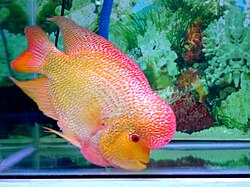
Flowerhorns are bred for boldness, and a peaceful juvenile can become a fish that rams tank mates, attacks the glass, bites your hand during water changes or turns on the partner it has lived with for months. Owners understandably wonder whether something is wrong. Usually nothing is: the flowerhorn is a hybrid of Central American cichlids — the Midas cichlid, the red devil, Vieja melanurus and Amphilophus trimaculatus are all reported parents[1] — and these are substrate-spawning fish that claim a territory and defend it, hardest of all when breeding.[2]
What matters is working out why aggression rose now, because each trigger has a different fix. Research on the Midas cichlid, one of the flowerhorn's parent species, found that aggression was significantly lower in a large aquarium with complex habitat, and that tanks of the sizes typical in the pet hobby did not give these fish good welfare.[3] Sudden aggression is best treated as information about the fish's space, its breeding state and what it can see, rather than as a behaviour to be medicated.
Why Is My Flowerhorn Suddenly Aggressive? The Common Causes
Reaching Maturity and Getting Ready to Breed
Most LikelyThis is the most common reason a previously calm flowerhorn changes. As the fish matures it starts to claim ground and look for a partner, and breeding aggression in its parent species is well documented. In a study of red devils (Amphilophus labiatus), a reported flowerhorn parent,[1] males were most aggressive towards intruders when the pair had just formed, while females increased their territory defence steadily and were most aggressive once the fry were free-swimming.[2] In a tank, the "intruder" is often a tank mate, a partner that is not ready, or your hand.
Clues that breeding is behind it: the fish is cleaning a flat stone or the glass, digging pits, showing its brightest colours and flaring, or a female has laid eggs — female flowerhorns lay eggs even without a male and will guard them. A male housed with a female that is not ready to spawn may batter her badly, and after a spawn one fish often turns on the other. This is not a sign of illness, but it can kill a tank mate, so it needs managing rather than waiting out.
A Change of Territory
Most LikelyAnything that redraws the map of the tank can restart territorial fights: a new tank mate, a fish returned after time in a hospital tank, new rocks or wood, a rearranged layout, a divider removed, or a move to a new tank. Flowerhorns treat the whole tank as theirs, and a new arrival is a challenge to be settled.
Space and structure change how much fighting goes on. The Midas cichlid study found that small differences in tank size or group size made little difference to how much time fish spent behaving aggressively, but a large tank with complex habitat lowered aggression significantly.[3] In practice, a flowerhorn that has outgrown its tank, or lives in a bare tank with nowhere for others to escape its line of sight, keeps fighting.
Reflections and Things Outside the Tank
PossibleFlowerhorns attack what they see, and much of what they see is not really there. Fish respond aggressively to their mirror image as though it were another fish,[4] and the tank glass becomes a mirror when the room is darker than the tank, typically in the evening. A fish that suddenly spends its evenings charging the glass may be fighting itself. Other fish in a neighbouring tank, a pet or people walking past can also be treated as rivals.
Many keepers use a mirror deliberately to make a flowerhorn flare. The fish do not treat it as harmless play: in a laboratory study, males fighting their reflection showed the same aggression and hormone levels as fish fighting a real opponent, but higher activity in brain areas associated with fear.[4] Brief, occasional use is one thing; a mirror or reflective glass available all day keeps the fish in constant combat.
Guarding Eggs or a Chosen Spot (Attacking Hands)
PossibleFlowerhorns that bite or ram hands during maintenance are usually defending something: a cleaned stone, a pit in the substrate, eggs, or simply the part of the tank they have claimed. The red devil research shows how defence of a breeding site rises and shifts over the breeding cycle,[2] and a big flowerhorn can draw blood.
This often begins suddenly, when the fish reaches breeding condition, and it is not a sign that the fish is unwell or unhappy with you. It tends to ease once any eggs are gone and the fish drops out of breeding condition, although some individuals stay hand-aggressive.
Stress From Poor Water or Illness
Less CommonAggression driven purely by poor water is less common than owners fear, but stress and aggression are linked in both directions. UF/IFAS lists aggressive interactions between fish, crowding, poor water quality and handling among the main stressors, and explains that stress suppresses immunity and leaves fish open to disease.[5] Ammonia at low concentrations stresses fish and damages gills.[6]
If aggression comes with clamped fins, dull or dark colour, laboured breathing or refusal to eat, the fish is more likely unwell or in bad water than simply territorial. A sick flowerhorn is usually subdued rather than aggressive; a flowerhorn that becomes suddenly irritable and then lethargic needs a water test and a closer look.
How to Find the Trigger for Your Flowerhorn's Aggression
Start with the safety check, then work through the rest. Most cases become clear within a day of watching.
-
Check every tank mate for injuries
Look for torn fins, missing scales, split lips, a fish hiding in a corner or at the surface, or one that is not eating. Any real damage means separating the fish today with a solid divider or another tank, before working out why. Chronic harassment is a stressor in itself and leaves the victim open to disease.[5]
-
List everything that changed recently
New fish, returned fish, new decor, rearranged rocks, a moved tank, a removed divider, a new mirror or a new tank next to it. A change in the last few days that lines up with the aggression is usually the answer.[3]
-
Watch for breeding behaviour
Look for cleaning of a flat surface, digging, heightened colour, flaring at one particular fish, a visible breeding tube near the vent, or eggs. Note whether the aggression is aimed at one fish (often a potential partner or rival) or everything. Breeding-driven aggression usually has a target and a site.[2]
-
Watch the tank in the evening from across the room
If the fish charges the front or side glass most when the room lights are off and the tank light is on, it is likely fighting its own reflection.[4] Check what else it can see: another tank, a pet, a window, people passing.
-
Test the water
Test ammonia, nitrite, nitrate, pH and temperature. Ammonia and nitrite should read zero;[6] flowerhorns do best at 26–30 °C and pH 7.0–7.8. A good result lets you rule out water as a driver and focus on behaviour. A water sample and history are also where an aquatic vet starts.[7]
Recommended: Water test kit
How to Calm an Aggressive Flowerhorn
-
Separate before anyone is injured
Use a solid or perforated divider fixed firmly (a large flowerhorn can push past loose ones), or move the victim to another tank. If you keep a pair, many keepers house them divided and only let them meet when both are clearly ready to spawn, removing one if fighting resumes. Most flowerhorns are best kept on their own; a flowerhorn with no tank mates cannot hurt one.
-
Give more space and break the lines of sight
Aggression was lowest in a large tank with complex habitat in the Midas cichlid study,[3] so upgrade the tank if the fish has outgrown it, and add rocks, wood or other heavy structures that block sight across the tank. When you introduce or reintroduce any fish, rearrange the whole layout first so that territories are reset rather than defended.
-
Remove reflections and limit mirror use
Keep the room lit when the tank light is on, apply a background to the sides and back, and screen off neighbouring tanks. If you use a mirror to make the fish flare, keep sessions short and occasional; fish treat the image as a rival and show fear-related brain activity when fighting it.[4]
-
Work safely around a guarding fish
Remove eggs or rearrange the chosen spawning site if you do not want breeding. Do maintenance quickly, keep hands away from the fish's claimed spot, and use long tools or a divider to confine the fish while you work. Wear gloves if the fish bites, which also protects cuts from tank water.
-
Correct the water and reduce other stressors
If ammonia or nitrite is detectable, do partial water changes with dechlorinated, temperature-matched water and reduce feeding until readings are zero.[6] Keep the tank in a quiet place and avoid tapping or frequent netting. Less stress means fewer fights and fewer secondary infections in fish that have already been attacked.[5]
Preventing Aggression Problems in Flowerhorns
When Aggression Needs More Than Rearranging
🔬 AI Symptom Checker
Not sure what's wrong? Describe your fish's symptoms to the FishCare AI symptom checker for a second opinion before you treat.
Check Symptoms →Frequently Asked Questions
Why is my flowerhorn attacking my hand?
Why did my flowerhorn start attacking its tank mate after months together?
Is it good to use a mirror for my flowerhorn?
Why is my male flowerhorn attacking the female?
Will my flowerhorn calm down?
Can bad water make a flowerhorn aggressive?
This guide was researched against the veterinary and scientific sources listed below and reviewed for biological accuracy. Test water parameters before treating a sick fish, and consult an aquatic veterinarian if symptoms persist after 48 hours of correct treatment.
References
- Sari, D.W.K., Achmad, H., Rahman, H. & Bimasuci, H. (2023). Molecular Identification of Several Morphologically Distinct Flowerhorn Fish (Family) Using Mitochondrial COI Gene Marker. Journal of Tropical Biodiversity and Biotechnology 8(2): 78459. doi:10.22146/jtbb.78459
- Sowersby, W., Lehtonen, T.K. & Wong, B.B.M. (2016). Temporal and sex-specific patterns of breeding territory defense in a color-polymorphic cichlid fish. Hydrobiologia 791(1): 237–245. doi:10.1007/s10750-016-2889-1
- Oldfield, R.G. (2011). Aggression and Welfare in a Common Aquarium Fish, the Midas Cichlid. Journal of Applied Animal Welfare Science 14(4): 340–360. doi:10.1080/10888705.2011.600664
- Desjardins, J.K. & Fernald, R.D. (2010). What do fish make of mirror images? Biology Letters 6(6): 744–747. doi:10.1098/rsbl.2010.0247
- Francis-Floyd, R. Stress—Its Role in Fish Disease. UF/IFAS Extension, Circular 919 (FA005). ask.ifas.ufl.edu
- Francis-Floyd, R., Watson, C., Petty, D. & Pouder, D.B. (2022). Ammonia in Aquatic Systems. UF/IFAS Extension, FA16 (FA031). doi:10.32473/edis-fa031-2022
- Merck Veterinary Manual. Management of Aquarium Fish. Merck & Co., Inc. merckvetmanual.com