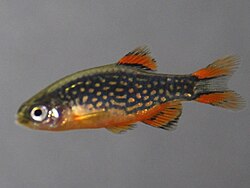
Black spots on a Celestial Pearl Danio (Danio margaritatus) are not automatically a sign of disease. This species is naturally dark-bodied and covered in pale, pearl-like spots — the name margaritatus literally means "adorned with pearls" — and the dark background between those pearls can look deeper or paler depending on maturity, sex, lighting and the colour of the substrate.[1][2][11] The marks that matter are new ones: discrete dark dots that were not there last week, raised nodules, or dark areas over damaged skin. What the appearance cannot tell you is the cause, so the first steps are water testing and careful observation, not medication.[3]
Common Causes of Black Spots in Celestial Pearl Danio
Ich (Ichthyophthirius multifiliis)
Less CommonIch is one of the most commonly diagnosed parasites of aquarium fish, but its hallmark lesion is white, not black. The feeding stage sits beneath the epidermis and becomes visible as white dots roughly 0.5–1 mm across, usually alongside flashing, rubbing and increased gill movement.[4] Black marks are therefore not a typical presentation of ich, and dark spots on a Celestial Pearl Danio with no white specks anywhere on the body or fins point away from this diagnosis. Ich is worth considering only if you can also see pinhead-sized white specks, or if dark marks have appeared where white spots recently detached and the skin is repairing. Confirmation comes from microscopy of a skin or gill wet mount, where the parasite's horseshoe-shaped macronucleus is diagnostic — never from colour alone.[4]
Fin Rot
Most LikelyBacterial disease can discolour tissue, so it is worth ruling out, but what it usually produces is erosion at the fin margin, ragged or milky edges and reddening at the fin base rather than discrete round black dots on the flank.[5] Columnaris (Flavobacterium columnare) and Aeromonas infections are associated with poor water quality and other stressful conditions, and Aeromonas can progress to haemorrhage and deep ulcers.[5] Check the fin edges under strong light: intact, evenly shaped fins argue against fin rot whatever the body colour is doing. If tissue is genuinely eroding, correct water quality first — and where antimicrobials are used, drug selection should be based on sensitivity testing wherever possible rather than on appearance.[5]
Stress
PossibleStress does not create spots, but it does change colour and lower resistance. Teleost fish adjust skin tone through melanophores under neural and hormonal control: α-melanocyte-stimulating hormone disperses pigment and darkens the fish, while melanin-concentrating hormone aggregates it and lightens the fish.[13] Over longer periods, background colour and chronic stress measurably alter both pigmentation and stress physiology, with fish held over dark backgrounds becoming darker.[11] Separately, chronic stress and sustained cortisol elevation suppress immune function in fish, which increases the chance that an infection establishes.[12] Practically, this usually shows as overall or patchy darkening that reverses when the fish settles — so check group size, planting, cover and tank mates before reaching for a bottle.
Poor Diet
PossibleDiet is unlikely to produce black marks on a Celestial Pearl Danio by itself, and no published work links a specific nutrient deficiency to black spotting in this species. What is documented is that deficient diets damage fish tissue and antioxidant defence: experimental vitamin E deficiency in carp produced skeletal muscle atrophy, liver degeneration, anaemia and elevated oxidative-stress markers.[14] Celestial Pearl Danios are micropredators barely 2 cm long with very small mouths[1], so stale flake, a single food type, or particles too large to swallow can leave them chronically underfed and less able to cope with other problems. Treat diet as a background risk factor worth correcting, not as an explanation for the spots.
External Parasites
Less CommonAnchor worm (Lernaea) embeds in the skin and shows as a barb-like attachment with local haemorrhage and tissue destruction — a protruding parasite you can see, not a flat black dot.[4] The parasites genuinely associated with black spots are digenean trematode metacercariae: the larva encysts in the skin and the fish walls it off with melanin, producing black, slightly raised nodules often less than 1 mm across.[6] These melanised lesions have been characterised in detail for Cryptocotyle spp. in wild fish.[8] More than 30 parasite species can produce similar black-spot signs, so appearance alone identifies nothing.[7] Crucially, these flukes need a snail intermediate host and a fish-eating final host, and reported ornamental-fish outbreaks have involved outdoor ponds with snails.[6][9]
How to Diagnose
Follow these steps in order. Stop when you identify a likely cause and move to treatment.
-
Observe the fish's behavior and appearance
Watch for two or three minutes before touching anything. Note whether the fish feeds, holds its place in the shoal and breathes at a normal rate, and look for flashing or rubbing against decor, clamped fins, persistent hiding or loss of balance. Then examine the marks under strong light: flat or raised? Discrete dots or a diffuse dark wash? On both flanks or one? On skin or on fin tissue? Photograph both sides and repeat in three to five days — whether the black marks on your Celestial Pearl Danio are stable, fading or multiplying is far more informative than any single look. A fish eating, shoaling and breathing normally with stable pigment is a monitoring case.
-
Check water parameters
Test ammonia, nitrite, nitrate, pH and temperature before considering any medication; water analysis together with a full history is the recommended starting point of a fish workup.[3] In an established aquarium, ammonia and nitrite should read zero — any detectable reading points to an immature or overloaded biofilter. New tank syndrome typically appears within the first six weeks, when total ammonia nitrogen or nitrite or both reach toxic concentrations and fish become lethargic and stop eating.[3] Confirm temperature and pH suit the species. Note the limit of this test: poor water quality explains stress and illness in general, but it does not prove that a specific dark mark is an "ammonia burn".
Recommended: pH test kit -
Inspect the tank for signs of other fish health issues
Check every fish, including other species, under the same lighting. If several fish develop similar new marks over the same period, a shared cause moves up the list — water quality, a recent introduction, or a transmissible organism. If only one Celestial Pearl Danio is affected while its tank mates look normal, localised injury, bullying or that individual's own pigmentation deserve more weight. Look too for the signs you would expect to accompany an infectious cause: white specks, eroded fin margins, reddening, ulcers, excess mucus, or several fish flashing at once.[4][5] Their absence is itself useful evidence and should push you toward observation rather than treatment.
-
Consider the fish's recent diet and environment
Reconstruct the last few weeks in writing. Was the fish recently bought, moved or added to a new tank? Did you change substrate, lighting or background — a darker background alone can darken fish as melanophores respond to it.[11] Did you add plants, snails, or fish originating from outdoor pond systems, which is the realistic route by which trematode-associated black spot could reach an indoor aquarium?[6][9] Has food changed, or is it too large for a micropredator with a tiny mouth?[1] Matching the appearance of the dark spots to a specific change in the timeline is often the most useful diagnostic step available to an owner.
-
Microscope examination
Appearance cannot confirm what a black spot is; confirmation requires looking at tissue. Standard practice is a skin scrape, fin clip and gill biopsy prepared as a wet mount and examined at 40×, 100× and 400×, using water from the fish's own system.[3][4] For black spot disease specifically, diagnosis is confirmed by observing the encysted metacercaria in a wet mount or histological section, where the capsule is ringed by melanocytes.[6] Because this means restraining a fish around 2 cm long[1], this step is best carried out by an aquatic veterinarian rather than attempted at home on a species this small.
Recommended: microscope
How to Fix It
-
Improve water quality
This is husbandry, and it comes first whatever the diagnosis turns out to be. If ammonia or nitrite is detectable, change water promptly, reduce feeding and reassess biofiltration; at least 50% of the water should be changed when total ammonia reaches around 2 mg/L, and chloride can be added for nitrite toxicity.[3] Dechlorinate and temperature-match replacement water, and avoid stripping or replacing filter media, which sets the biofilter back. Correcting water quality is not a treatment for a parasite, but it removes the single most common driver of stress and secondary infection in aquarium fish — and in many cases the fish improves without any medication at all.[3]
-
Use appropriate medication
Medicate only for a condition you have identified or strongly suspect, never for colour alone. If microscopy confirms ich, treatment targets the free-living stages; formalin or copper are standard agents, and three to seven treatments may be required depending on water temperature.[4] If tissue is eroding and bacterial disease is likely, base drug selection on sensitivity testing where that is possible.[5] For trematode-associated black spot disease there is no established aquarium cure — the larvae are encysted inside host tissue, most skin and fin infestations are relatively non-pathogenic, and control means breaking the life cycle by excluding snails and infected stock rather than dosing the tank.[6]
-
Remove stress factors
Supportive care, appropriate in almost every case. Keep Celestial Pearl Danios in a reasonable group with dense planting and broken sightlines, and avoid boisterous or much larger tank mates that keep a 2 cm fish hiding.[1] Hold temperature and chemistry stable rather than chasing ideal numbers, soften harsh lighting, and minimise netting and handling. Chronic stress elevates cortisol and suppresses immune function in fish, which slows recovery and makes secondary infection more likely.[12] Bear in mind that a dark substrate or background can itself darken the fish through melanophore responses — a cosmetic effect, not a clinical one.[11]
-
Adjust diet
Also supportive care. Offer small, varied, appropriately sized foods and confirm that each fish is actually eating, since timid individuals are easily outcompeted. Feed modestly and remove uneaten food: surplus feed loads the filter and drives exactly the water-quality problems described above.[3] A sound diet supports tissue integrity and antioxidant defence, and deficiency demonstrably undermines both[14], but no dietary change will clear an encysted parasite or reverse established pigmentation. Treat nutrition as groundwork that helps the fish recover from whatever the real problem is, rather than as the treatment itself.
-
Monitor the fish's response
Keep photographing both flanks under the same lighting every few days and log water tests beside the images. Judge progress by the fish rather than the marks: appetite, shoaling, respiration and fin condition recover first, while pigment changes slowly and melanised tissue can persist long after the underlying process has resolved, because melano-macrophages remain at former sites of inflammation.[10] Spots that hold steady in size and number while the fish behaves normally are an acceptable outcome, not treatment failure. Escalate if marks multiply quickly, ulcerate, or new signs appear — and finish any medication course rather than dosing indefinitely.
Prevention
When to Seek Expert Help
🔬 AI Symptom Checker
Not sure what's wrong? Describe your fish's symptoms to the FishCare AI and get an instant diagnosis.
Check Symptoms →Frequently Asked Questions
Can black spots be prevented in Celestial Pearl Danio?
What should I do if I notice black spots on my Celestial Pearl Danio?
Are black spots on Celestial Pearl Danio contagious?
How long does it take for black spots to heal in Celestial Pearl Danio?
Can stress cause black spots in Celestial Pearl Danio?
This guide was reviewed for biological accuracy and practical aquarium care guidance. Always test water parameters before treating a sick fish — husbandry faults are the most common root cause, and appearance alone cannot identify what a black spot is. Consult an aquatic veterinarian if symptoms persist after 48 hours of correct treatment.
References
- Roberts, T.R. (2007). The "celestial pearl danio", a new genus and species of colourful minute cyprinid fish from Myanmar (Pisces: Cypriniformes). The Raffles Bulletin of Zoology 55(1): 131–140. PDF
- Conway, K.W., Chen, W.-J. & Mayden, R.L. (2008). The "Celestial Pearl danio" is a miniature Danio (s.s) (Ostariophysi: Cyprinidae): evidence from morphology and molecules. Zootaxa 1686(1): 1–28. doi:10.11646/zootaxa.1686.1.1
- Merck Veterinary Manual. Management of Aquarium Fish. Merck & Co., Inc. merckvetmanual.com
- Merck Veterinary Manual. Parasitic Diseases of Fish. Merck & Co., Inc. merckvetmanual.com
- Merck Veterinary Manual. Bacterial Diseases of Fish. Merck & Co., Inc. merckvetmanual.com
- Alaska Department of Fish and Game. Black Spot Disease (Neascus and Heterophyids), in Diseases of Wild and Cultured Fishes in Alaska, pp. 78–79. PDF
- Kurochkin, I.V. & Biserova, L.I. (1996). [The etiology and diagnosis of "black spot disease" of fish]. Parazitologiia 30(2): 117–125. PMID 8984434
- Duflot, M. et al. (2023). Black spot diseases in seven commercial fish species from the English Channel and the North Sea: infestation levels, identification and population genetics of Cryptocotyle spp. Parasite 30: 28. parasite-journal.org
- López-Hernández, D., Leibowitz, M.P., Pinto, H.A. & Leal, C.A.G. (2023). First report of Crassiphiala sp. (Trematoda: Diplostomidae) as an etiological agent of black spot disease in commercial ornamental fish from Brazil. Parasitology Research 122(4): 1037–1042. doi:10.1007/s00436-023-07794-7
- Bjørgen, H., Rimstad, E. & Koppang, E.O. (2025). Melanisation in salmonid skeletal muscle: a review. Journal of Fish Diseases. doi:10.1111/jfd.14063
- van der Salm, A.L., Spanings, F.A.T., Gresnigt, R., Wendelaar Bonga, S.E. & Flik, G. (2005). Background adaptation and water acidification affect pigmentation and stress physiology of tilapia, Oreochromis mossambicus. General and Comparative Endocrinology 144(1): 51–59.
- Tort, L. (2011). Stress and immune modulation in fish. Developmental and Comparative Immunology 35(12): 1366–1375. PMID 21782845
- Cal, L., Suarez-Bregua, P., Cerdá-Reverter, J.M., Braasch, I. & Rotllant, J. (2017). Fish pigmentation and the melanocortin system. Comparative Biochemistry and Physiology Part A 211: 26–33. doi:10.1016/j.cbpa.2017.06.001
- Wang, K., Wang, E., Qin, Z., Zhou, Z., Geng, Y. & Chen, D. (2016). Effects of dietary vitamin E deficiency on systematic pathological changes and oxidative stress in fish. Oncotarget 7(51): 83869–83879. doi:10.18632/oncotarget.13729