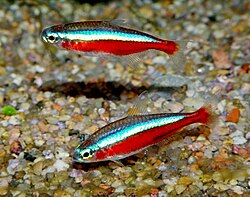
Cardinal tetras change colour far more than most owners expect. Both the red that runs the full length of the belly and the electric blue line above it are under the fish's physiological control: the red pigment cells blanch at night under the influence of the hormone melatonin,[1] and the colour of the blue stripe shifts with light and with the fish's state of arousal.[2] A cardinal that looks washed-out, greyish or "transparent" first thing in the morning is showing the same night-time camouflage it would use in the wild,[2] not illness.
Colour loss that does not recover during the day is different. Cardinals are blackwater fish from the soft, acidic, ion-poor rivers of the Rio Negro and upper Orinoco, and many of those sold are still caught wild and shipped long distances,[3][4] so stress from transport, a new tank, too few companions or water that is nothing like home is the usual explanation. Less often, fading is the first visible sign of disease — most importantly neon tetra disease, which cannot be cured.[5] The checks below separate these in a few days without medicating anything.
Why Is My Cardinal Tetra Losing Its Color? The Common Causes
Normal Night-Time and Early-Morning Fade
Most LikelyThis is the most common reason people search for this problem, and it is harmless. In a laboratory study of neon and cardinal tetras, the red abdominal skin of both species blanched at night or whenever the fish were kept in the dark. The red pigment granules inside the pigment cells (erythrophores) clump into the centre of each cell, so the colour almost disappears; melatonin, the night-time hormone produced by the pineal gland, was the most effective trigger.[1] Earlier work on the same fish concluded that neon and cardinal tetras are conspicuous in daylight, when they are active, and camouflaged at night, when they rest — the iridescent stripe darkens and the red areas fade.[2]
In an aquarium this shows up as a group of cardinals that look pale, dull or grey at dawn, when you switch the light on suddenly, or when you check them with a torch at night. They colour up again over the following minutes to an hour once they are awake and moving. If every cardinal fades together and recovers together, you are watching a daily rhythm, not a disease.
Stress: New Arrivals, Small Groups and Disturbance
Most LikelyCardinals are also pale when frightened or stressed, and it is easy to see why. The same red pigment cells that respond to melatonin also pull their pigment in when exposed to norepinephrine,[1] the nerve messenger of the fight-or-flight response, and the blue stripe changes with emotional arousal.[2] A chase by a tankmate, a hand in the tank, re-arranged décor or a net will all wash colour out within seconds.
Longer-lasting stress keeps them pale for days. The cardinal is the most important ornamental fish in the world market and makes up more than 80% of the ornamental fish exported from the Rio Negro each year, with fish collected by local fishermen,[3] and measurable stress-hormone (cortisol) and ion-balance responses have been documented in cardinals during the long transport chain out of the Amazon.[4] Newly bought cardinals are therefore often pale for the first one to two weeks. Group size matters too: in a study of neon tetras — the cardinal's close relative — aggression and darting were lowest and feeding quickest in the largest groups, and groups of ten shoaled the most.[6] Three or four cardinals in a large tank with boisterous companions tend to stay pale and hide.
Bright Light and a Bare, Pale Tank
PossibleThis one is specific to cardinals and is backed by a direct experiment. Researchers in Manaus exposed cardinal tetras to light intensities from darkness up to 2,700 lux for up to 72 hours. Under intense light the dark band and the blue "neon" stripe became pale because the density of melanophores (the dark pigment cells behind the stripe) fell, while under low light of 0–250 lux melanophores increased and the colours became more vivid.[7] The authors suggest this is a camouflage response suited to the dark, tea-coloured water of the Rio Negro.
Interestingly, the red band did not fade in that study — it actually intensified under bright light.[7] So a cardinal that keeps its red but whose blue line looks dull, silvery or washed-out, in a brightly lit tank with a pale gravel and little cover, is probably responding to the light. Dimmer lighting, floating plants and a dark substrate usually bring the blue back within days to weeks.
Water Chemistry and Water Quality
PossibleCardinals are built for water that most tap water is not. Physiologists working on the Rio Negro found that cardinals held at pH 6.0, 4.0 or even 3.5 for five days kept their body sodium stable,[8] and cardinals have a high capacity to take up sodium and calcium from soft, ion-poor water, helped by the humic substances that stain blackwater brown.[9] No controlled study has shown that hard, alkaline water alone turns cardinals pale, and many farmed fish adapt to moderate conditions. But the species' comfort zone is soft, acidic water, and chronic mismatch is a plausible background stress when colour never fully develops.
A more immediate problem is instability. Very soft water has little buffering, and the Merck Veterinary Manual notes that when alkalinity is depleted in poorly maintained tanks the pH can drop gradually or suddenly — the rapid version can kill fish — and that alkalinity of 50 mg/L or less also impairs the biological filter.[10] In new tanks, ammonia and nitrite from an immature filter cause lethargy, loss of appetite and deaths within the first weeks.[10] Pale, listless cardinals in a tank that is less than two months old or overdue for a water change should prompt a full water test before anything else.
Neon Tetra Disease (Pleistophora)
Less CommonNeon tetra disease is caused by Pleistophora hyphessobryconis, a microsporidian parasite that invades skeletal muscle. The Merck Veterinary Manual lists tetras among its hosts, describes abnormal swimming caused by muscle damage and muscle that looks marbled at post-mortem, and states that microsporidia are considered untreatable.[5] Research on laboratory outbreaks describes large, depigmented regions around the dorsal fin in severely infected fish, and a host range that spans many aquarium species in several families.[11] It is named after the neon tetra, the cardinal's closest relative in the trade; we found no published estimate of how often cardinals are affected, so assume a cardinal sharing a tank with infected fish is at risk.
The pattern is what points to it: one fish, not the whole group, with a whitish or opaque patch in the muscle under the skin — often starting near the dorsal fin or across the blue stripe — that stays pale in daylight and slowly spreads. Restless or uncoordinated swimming, a bent spine, weight loss and the fish drifting away from the shoal often follow. Remove such a fish promptly.
Other Chronic Illness, Including Mycobacteriosis
Less CommonMerck lists paleness among the signs of mycobacteriosis, together with emaciation, skin ulcers, bulging eyes and skeletal deformities, and notes that no treatment eliminates the bacteria from fish.[12] More generally, bacterial disease outbreaks follow poor water quality, handling and transport, temperature swings and other stress.[12] Any cardinal that is pale and thin, not eating, hanging alone near the surface or showing sores is sick rather than merely stressed, and the colour change is a symptom, not the problem to solve.
How to Tell Why Your Cardinal Tetra Is Pale
Work through these in order. Most pale cardinals are explained by the first two checks, and none of them involves medication.
-
Look again an hour after the lights come on
Cardinals are routinely pale at dawn and after sudden lights-on, because the red belly blanches at night.[1] Judge colour only after the tank light has been on for at least an hour and the fish are swimming and feeding. If they have coloured up by then, you have your answer.
-
Decide whether it is the whole group or one fish
The whole shoal fading together points to something in the environment — light, stress, water. One fish that stays pale while its companions are bright points to that individual: injury, bullying or disease, including neon tetra disease.[11]
-
Note which colour has faded
Red intact but blue stripe dull or silvery: consider bright lighting, which pales the dark and blue bands in cardinals.[7] Red and blue both faded evenly: stress, night fade or water. A patchy white or opaque area in the muscle, especially near the dorsal fin, that does not change with the lights: suspect neon tetra disease.[5]
-
Test the water, including pH and hardness
Test ammonia, nitrite, nitrate, pH and — if you can — carbonate hardness (KH). Ammonia and nitrite should be undetectable. In a soft-water tank, a pH that is much lower than usual together with very low KH suggests the buffering has run out, which Merck describes as a cause of sudden pH crashes.[10] Cardinals do best at about 23–27 °C in soft, acidic water.
Recommended: Water test kit (ammonia, nitrite, nitrate, pH, KH) -
List what changed in the last two weeks
New fish (and whether these cardinals are the new ones), a move, new lighting or a longer photoperiod, new or larger tankmates, a big water change with differently conditioned water, or removal of plants. Recently imported cardinals are frequently pale for a week or two after the stress of transport.[4]
-
Watch swimming, body shape and appetite for a few days
A pale cardinal that feeds and schools normally is almost always stressed or adapting. One that is thin, swims jerkily or stiffly, curves its spine or stays apart from the group needs to be isolated and watched closely, because those signs go with muscle disease and chronic infection.[5][12]
How to Bring a Cardinal Tetra's Color Back
-
If it is night fade: do nothing, but keep a regular day
Run the light on a timer for a consistent 8–10 hours, avoid switching it on suddenly in a dark room if you can, and judge colour in the middle of the day. The fade is a normal camouflage response and needs no treatment.[2]
-
Settle stressed fish: bigger group, more cover, dimmer light
Keep cardinals in a group of at least 8–10, since shoaling tetras behave more calmly in larger groups.[6] Add floating plants or leaf litter, use a dark substrate or background, and reduce light intensity — low light enhanced the blue and dark bands in the cardinal study.[7] Remove or rehome fast, nippy or much larger tankmates. New cardinals usually show full colour within one to three weeks once they settle.
-
Correct and stabilise the water
Fix any ammonia or nitrite with partial water changes and lighter feeding. Keep soft water stable rather than chasing a number: change water regularly with water of the same temperature and similar hardness, and do not let the tank run for weeks with only top-ups, which is how old tank syndrome and pH crashes develop.[10] If your tap water is hard, softening it gradually with reverse-osmosis water gets closer to the conditions cardinals are adapted to,[8][9] but any change should be made over days, not in one go.
-
If one fish has a spreading pale patch: isolate it and assume neon tetra disease
There is no reliable cure for microsporidian infections; Merck recommends removing affected and dying fish, UV sterilisation and strict biosecurity.[5] Remove the fish promptly — dead fish get picked at by tankmates, and the parasite spreads directly from fish to fish[11] — do not add new tetras for several months, and ask an aquatic vet to examine a fish if you need a firm diagnosis — the spores are easy to see under a microscope.[5]
-
Quarantine new cardinals before adding them
Hold new fish in a separate tank for at least 30 days, the minimum Merck recommends,[10] with dim light and cover. This lets transport stress pass, lets the colour return where you can see it, and keeps a fish that turns out to have neon tetra disease or another infection away from your established group.
Keeping Cardinal Tetras Brightly Coloured
When a Pale Cardinal Tetra Needs Expert Help
🔬 AI Symptom Checker
Not sure what's wrong? Describe your fish's symptoms to the FishCare AI symptom checker for a second opinion before you treat.
Check Symptoms →Frequently Asked Questions
Why do my cardinal tetras lose their color at night?
My new cardinal tetras have no color. Will it come back?
Is my pale cardinal tetra sick with neon tetra disease?
Why is my cardinal tetra's blue stripe fading but the red is fine?
Do cardinal tetras need soft, acidic water to keep their color?
What is the difference between a pale cardinal and a pale neon tetra?
This guide was researched against the veterinary and scientific sources listed below and reviewed for biological accuracy. Test water parameters before treating a sick fish, and consult an aquatic veterinarian if symptoms persist after 48 hours of correct treatment.
References
- Hayashi, H., Sugimoto, M., Oshima, N. & Fujii, R. (1993). Circadian motile activity of erythrophores in the red abdominal skin of tetra fishes and its possible significance in chromatic adaptation. Pigment Cell Research 6(1): 29–36. doi:10.1111/j.1600-0749.1993.tb00578.x
- Lythgoe, J.N. & Shand, J. (1983). Diel colour changes in the neon tetra Paracheirodon innesi. Environmental Biology of Fishes 8(3–4): 249–254. doi:10.1007/BF00001090
- Sanchez-Bernal, D., Martinez, J.G., Farias, I.P., Hrbek, T. & Caballero, S. (2023). Phylogeography and population genetic structure of the cardinal tetra (Paracheirodon axelrodi) in the Orinoco basin and Negro River (Amazon basin): evaluating connectivity and historical patterns of diversification. PeerJ 11: e15117. doi:10.7717/peerj.15117
- Baldisserotto, B., Brinn, R.P., Brandão, F.R., Gomes, L.C., Abreu, J.S., McComb, D.M. & Marcon, J.L. (2014). Ion flux and cortisol responses of cardinal tetra, Paracheirodon axelrodi (Schultz, 1956), to additives (tetracycline, tetracycline + salt or Amquel®) used during transportation: contributions to Amazonian ornamental fish trade. Journal of Applied Ichthyology 30(1): 86–92. doi:10.1111/jai.12282
- Merck Veterinary Manual. Mycotic Diseases of Fish. Merck & Co., Inc. merckvetmanual.com
- Saxby, A., Adams, L., Snellgrove, D., Wilson, R.W. & Sloman, K.A. (2010). The effect of group size on the behaviour and welfare of four fish species commonly kept in home aquaria. Applied Animal Behaviour Science 125(3–4): 195–205. doi:10.1016/j.applanim.2010.04.008
- Linhares, R.M., Pinagé, C.M.M.F. & Duncan, W.P. (2018). Excessive luminosity fades the skin color of cardinal tetra. Boletim do Instituto de Pesca 44(4). doi:10.20950/1678-2305.2018.44.4.319
- Gonzalez, R.J., Wood, C.M., Wilson, R.W., Patrick, M.L., Bergman, H.L., Narahara, A. & Val, A.L. (1998). Effects of water pH and calcium concentration on ion balance in fish of the Rio Negro, Amazon. Physiological Zoology 71(1): 15–22. doi:10.1086/515893
- Matsuo, A.Y.O. & Val, A.L. (2007). Acclimation to humic substances prevents whole body sodium loss and stimulates branchial calcium uptake capacity in cardinal tetras Paracheirodon axelrodi (Schultz) subjected to extremely low pH. Journal of Fish Biology 70(4): 989–1000. doi:10.1111/j.1095-8649.2007.01358.x
- Merck Veterinary Manual. Management of Aquarium Fish. Merck & Co., Inc. merckvetmanual.com
- Sanders, J.L., Watral, V. & Kent, M.L. (2012). Microsporidiosis in zebrafish research facilities. ILAR Journal 53(2): 106–113. doi:10.1093/ilar.53.2.106
- Merck Veterinary Manual. Bacterial Diseases of Fish. Merck & Co., Inc. merckvetmanual.com