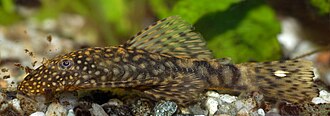
Bristlenose plecos (Ancistrus) are small — the ones commonly kept reach about 13 cm[1] — peaceful with other species, and among the easiest plecos to breed. That last point is why their fins get torn. Male Ancistrus are cave-nesters: each male picks a dark cavity in wood or rock, defends it against all intruders, especially other males, and guards the eggs and fry inside it.[2] Put two or three males in a tank with one good cave and they will fight over it, mostly at night when you are not watching.
Bristlenose males are armed for this. Bristlenose plecos have sharp, evertible cheek spines (enlarged odontodes, or skin teeth) that are usually better developed in males and are used in displays and combat; they also have odontodes along the fin spines, and mature males carry the fleshy snout tentacles ("bristles") that make them easy to recognise.[2] A torn dorsal fin, split tail or scraped cheek on a bristlenose is therefore often a fight injury rather than disease. The checks below tell you which it is, and how to stop it recurring.
Why Does My Bristlenose Pleco Have Torn Fins? The Common Causes
Males fighting over caves
Most LikelyThis is the most common cause in tanks with more than one bristlenose. Nesting males are extremely territorial and aggressively defend their nest cavity from rival males.[2] Fights follow a set pattern: the two males line up side by side, head to tail, with the dorsal and tail fins raised and the cheek spines flared out; if neither backs down, they circle each other and attack the opponent's head.[2] Raised fins in close contact with a rival's cheek spines and armoured body are what get split and torn, and the loser often shows damage to the dorsal and tail fins and scrapes around the head.
Fights are worst when a male is guarding a clutch or fry. Parental males stay in the cave, clean the eggs and fan them with their pectoral fins for days, and a male that takes over another's nest may eat the eggs he finds there,[2] so there is a lot at stake. Tanks with a breeding pair and young males growing up, or several adult males and only one or two caves, are where torn fins appear most often.
Larger or nippy tank mates
PossibleA bristlenose is small and slow, and it is often kept in community tanks with fish that nip. Tiger barbs, some tetras and serpae-type fish pick at fins, and territorial cichlids — even small ones such as convicts guarding fry — will bite a pleco that comes near their territory at night. A bristlenose kept with a much larger pleco, such as a common or sailfin pleco, may also be pushed out of caves and injured.
Tank-mate damage shows as crescent-shaped bites or ragged edges that appear overnight, usually on the dorsal and tail fins, in a pleco that otherwise eats and behaves normally. It continues until the aggressor is removed.
Fin rot (bacterial infection)
PossibleBacteria are always present in aquarium water and take advantage of stressed or injured fish. In catfish, Aeromonas infection typically causes fraying and reddening of the fins, sometimes with swollen, red fin bases and pale patches on the body that can become ulcers.[3] Columnaris, another common bacterial disease of warm-water fish, causes fin erosion that starts at the base of the fin and works outwards, and lesions around the dorsal fin.[4]
Fin rot differs from a fight wound in that it keeps getting worse: the edge looks ragged, white, grey or bloodshot and recedes towards the body over days. Poor water, heavy organic load, handling, temperature swings and low oxygen are the usual triggers of bacterial disease,[5] and a torn fin in a dirty tank is an easy way in, so fight damage and fin rot often occur together.
Snagged spines and physical injury
Less CommonThe cheek spines and the odontodes on the fin spines[2] hook easily into net mesh. Pulling a snagged bristlenose free tears fins and strips the protective mucus from the skin, and handling in itself is a recognised stressor that weakens the fish's defences.[6] Sharp rocks, rough ornaments and tight gaps behind heaters or filters can also cause tears, particularly in a fish that is being chased.
Poor water quality
Less CommonAmmonia and nitrite do not tear fins directly, but they keep them from healing. Even low ammonia levels cause stress and tissue damage and make fish more prone to bacterial infections.[7] Bristlenose tanks are often heavily stocked once a pair starts breeding, and dozens of growing fry on top of the adults can overload a filter that coped before. Frayed fins on several fish at once point to a water problem.
How to Tell Why Your Bristlenose Pleco's Fins Are Torn
Work through these checks. They tell you whether the damage is a fight injury, a tank-mate problem or an infection, and what to change.
-
Count the males
Look at each bristlenose's snout. Mature males have a large crop of fleshy tentacles over the snout; the tentacles are best developed in breeding males.[2] Females and young males have far smaller and fewer tentacles, restricted to a narrow band around the edge of the snout.[2] If you have two or more males and fewer good caves than males, cave fights are the likely cause.
-
Look at where the damage is
Fight damage usually affects the raised dorsal and tail fins and often comes with scrapes on the head and cheeks, because fighting males attack each other's heads.[2] Bites that are crescent-shaped suggest another species. Damage along the edges of all fins, with redness, suggests fin rot.[3]
-
Look closely at the fin edges and compare in two or three days
Clean splits with normal-coloured edges are injuries; a thin clear rim along the edge is usually new tissue regrowing. White, grey, fuzzy or bloodshot edges, or redness at the fin base, suggest infection.[3][4] Photograph the fin and compare after 48–72 hours: injuries hold steady and then fill in, fin rot gets worse.
-
Watch the tank after lights out
Bristlenose plecos are most active in the dark. Watch for 20–30 minutes after the lights go down with a dim torch, and look for males lining up with fins raised and cheek spines flared,[2] a male chasing others from a cave, or other species picking at the pleco.
-
Test the water
Test ammonia, nitrite, nitrate, pH and temperature. Ammonia and nitrite should both be zero in an established tank.[7] Keep the temperature steady at around 23–27 °C and the pH in the 6.5–7.5 range. Water analysis and a history of recent changes are the first step in any veterinary workup.[8]
Recommended: Water test kit
What to Do for a Bristlenose Pleco With Torn Fins
-
Give every male his own cave, out of sight of the others
Provide at least one cave per male, plus spares — clay caves, slate caves or short lengths of pipe that the fish can fit into completely, the kind of dark cavity males naturally choose for nests.[2] Place them at opposite ends of the tank and break up lines of sight with wood and plants. In a small tank, keep only one male.
-
Separate or rehome extra males and aggressive tank mates
If fights continue, move the losing male to another tank or rehome him. Grown-on young males from a breeding pair are a common source of trouble; remove them before they mature. Rehome fin-nipping or territorial species that are biting the pleco.
-
Keep the water clean and let the fins regrow
Keep ammonia and nitrite at zero with regular partial water changes; for any reading, reduce feeding and change 25–50% of the water with dechlorinated water at the same temperature until it is gone.[7] Fish fins regenerate well — in zebrafish, the best-studied example, an amputated fin is almost perfectly replaced[9] — and clean tears on a bristlenose usually fill in within a few weeks. Do not medicate a clean injury.
-
If the edges are receding, white or red: treat as fin rot
Correct the water first; removing sources of stress often corrects bacterial disease on its own.[3] Isolate the fish in a hospital tank if you can, and contact an aquatic veterinarian if the rot continues. Bacterial infections should be identified by culture, and sensitivity testing is recommended before an antibiotic is chosen;[5] follow the product label exactly and check for warnings about scaleless catfish.
-
Handle with a container, not a net
Catch bristlenose plecos by guiding them into a cup, a clear container or a cave you can lift out, rather than a net that their cheek and fin odontodes can snag in. Handling strips protective mucus and stresses the fish,[6] so keep it to a minimum while fins are healing.
Preventing Torn Fins in Bristlenose Plecos
When Torn Bristlenose Fins Need Expert Help
🔬 AI Symptom Checker
Not sure what's wrong? Describe your fish's symptoms to the FishCare AI symptom checker for a second opinion before you treat.
Check Symptoms →Frequently Asked Questions
Do male bristlenose plecos fight?
How can I tell a male bristlenose from a female?
How many bristlenose plecos can I keep together?
Will my bristlenose's fins grow back?
My male bristlenose stays in his cave and is not eating. Is that because of his fins?
Can a bristlenose get caught in a net?
This guide was researched against the veterinary and scientific sources listed below and reviewed for biological accuracy. Test water parameters before treating a sick fish, and consult an aquatic veterinarian if symptoms persist after 48 hours of correct treatment.
References
- Hill, J.E. & Yanong, R.P.E. Freshwater Ornamental Fish Commonly Cultured in Florida. UF/IFAS Extension, Circular 54 (FA054). ask.ifas.ufl.edu
- Sabaj, M.H., Armbruster, J.W. & Page, L.M. (1999). Spawning in Ancistrus (Siluriformes: Loricariidae) with comments on the evolution of snout tentacles as a novel reproductive strategy: larval mimicry. Ichthyological Exploration of Freshwaters 10(3): 217–229. auburn.edu
- Camus, A.C., Durborow, R.M., Hemstreet, W.G., Thune, R.L. & Hawke, J.P. (1998). Aeromonas Bacterial Infections — Motile Aeromonad Septicemia. Southern Regional Aquaculture Center, SRAC Publication No. 478. srac.msstate.edu
- Declercq, A.M., Haesebrouck, F., Van den Broeck, W., Bossier, P. & Decostere, A. (2013). Columnaris disease in fish: a review with emphasis on bacterium-host interactions. Veterinary Research 44: 27. doi:10.1186/1297-9716-44-27
- Merck Veterinary Manual. Bacterial Diseases of Fish. Merck & Co., Inc. merckvetmanual.com
- Francis-Floyd, R. Stress — Its Role in Fish Disease. UF/IFAS Extension, Circular 919 (FA005). ask.ifas.ufl.edu
- Francis-Floyd, R., Watson, C., Petty, D. & Pouder, D.B. Ammonia in Aquatic Systems. UF/IFAS Extension, FA16 (FA031). ask.ifas.ufl.edu
- Merck Veterinary Manual. Management of Aquarium Fish. Merck & Co., Inc. merckvetmanual.com
- Pfefferli, C. & Jaźwińska, A. (2015). The art of fin regeneration in zebrafish. Regeneration 2(2): 72–83. doi:10.1002/reg2.33