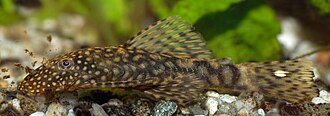
Bristlenose plecos (Ancistrus) are camouflage specialists. Like many fish, they can change shade within minutes by moving pigment inside their skin cells, a process that serves background matching, and that is controlled by light, hormones and the nervous system.[1] A bristlenose resting on dark driftwood can look almost black, and the same fish on pale sand or the white back of a filter can look washed-out grey or mottled beige. Owners often notice this for the first time when the fish is out in the open or after the lights come on, and assume it is sick.
So the first question is not what disease the fish has, but how long the paleness lasts and what comes with it. Colour that returns once the fish moves back to cover is normal. Colour that stays pale for days is the fish telling you something — most often that it is stressed, that the water is poor, that it is not getting enough to eat, or, less commonly, that it has parasites or an infection. The checks below separate those.
Why Is My Bristlenose Pleco Pale? The Common Causes
Normal Background and Light-Driven Colour Change
Most LikelyRapid colour change in fish is mediated by chromatophores — pigment cells whose dark granules cluster at the centre of the cell to lighten the skin, or spread out to darken it — and one of its main functions is matching the background.[1] Bristlenose have a mottled brown-and-grey pattern with pale spots, and when they lighten the pattern can look faded or blotchy. Common triggers are a light-coloured substrate, bright overhead lighting, the fish resting on a pale surface such as glass or a filter intake, and the change between night and day.
Over weeks, a fish kept on a consistently light or dark background can also adjust the amount of pigment in its skin. Background light conditions and social interactions are recognised drivers of this slower, morphological colour change in teleost fish.[2] That means a bristlenose kept in a bright, bare tank may simply be a lighter fish than one kept among dark wood and leaves. If your pleco is active at night, grazes normally, has a full belly and darkens when it returns to cover, the pale colour is behaviour, not illness.
Stress: New Tank, No Cover or Harassment
Most LikelyBristlenose are cave dwellers; males in particular select dark cavities in wood or rock and defend them.[3] A fish without a cave or a dark crevice to retreat into, one kept under strong light, or one being chased by other plecos or boisterous tankmates is under constant low-level stress, and stressed fish often look pale and blotchy. The same is true in the first days after purchase or a move.
Stress is not harmless: it compromises the fish's natural defences so that it cannot effectively protect itself from pathogens, and prolonged stress severely limits the immune system.[4] The stressors recognised by fish health specialists include poor water quality, crowding, aggression, bright light, handling and shipping.[4] A pale bristlenose that is also hiding all the time, or is repeatedly pushed out of every cave by a larger male, should be treated as a stressed fish.
Poor Water Quality
PossiblePlecos produce a lot of waste for their size and are often kept in tanks that are under-filtered for them. Ammonia is the most common hidden problem: at low concentrations it causes stress and damages the gills, fish exposed to it over time are more prone to bacterial infections, and because it is colourless and odourless the only way to detect it is to test the water.[5] The toxic un-ionised fraction increases as pH and temperature rise,[5] so a warm tank at the top of the bristlenose's 23–27 °C range with a pH above 7 is less forgiving.
Water-quality paleness usually affects more than one fish, often comes with faster breathing or fish sitting near the surface or the filter outflow, and follows an event such as a filter clean, a missed water change, overfeeding or a dead fish or snail left in the tank. It improves within a day or two of fixing the water.
Underfeeding and Poor Nutrition
PossibleNutrition is one of the primary factors behind longer-term colour change in fish,[2] and a hungry pleco is a surprisingly common problem. Many bristlenose are bought to eat algae and then given nothing else, or live in tanks where faster fish take every wafer before the pleco finds it. In the wild, loricariids feed on detritus and algae,[8] and even the wood-rasping species gain little from the wood itself: plecos fed wood in trials lost weight.[9] A bristlenose in a clean, algae-poor tank with only driftwood to graze may be slowly starving.
The tell-tale sign is the belly. Look at the fish from underneath while it is on the glass: a well-fed bristlenose has a gently rounded belly, while an underfed one has a flat or concave belly and a thin area behind the head. Pale colour together with a sunken belly means the fish needs more food, delivered after lights-out when it can find it.
Parasites and Infection
Less CommonSeveral external parasites cause paleness. With gill and skin flukes (monogeneans), fish become pale as their colours fade and breathe rapidly with swollen, pale gills; ciliates such as Chilodonella and trichodinids cause loss of condition, and Chilodonella often causes excess mucus.[6] White spot (Ichthyophthirius) is easy to recognise by its distinct white dots. Bacterial disease should be suspected when pale colour comes with white or grey patches, frayed fins, reddened areas or ulcers.
Chronic infection is a rarer cause. Mycobacteriosis, for example, produces variable, nonspecific signs that include paleness, emaciation, skin ulcers and bulging eyes.[7] Infection is most likely in a recently bought fish, in a tank where new fish were added without quarantine, or where the water has been poor for some time.
How to Tell Why Your Bristlenose Is Pale
Start with the simplest explanation. Most pale bristlenose are explained by the first two checks and need nothing more than cover and time.
-
Note when and where the fish looks pale
Is it pale only when it sits on sand, glass or the filter, only just after the lights come on, or only at night? Does it darken again when it moves onto wood or back into a cave? Colour that comes and goes with the background and the lighting is normal physiological colour change.[1] Take a photo in the morning and another in the evening for a couple of days; if the colour varies, it is behaviour, not disease.
-
Watch its behaviour and breathing
A healthy bristlenose hides in the day, comes out at dusk and grazes steadily. Rapid gill movement, gasping, sitting at the surface or near the filter outflow, repeated rubbing against surfaces, or clamped fins alongside the pale colour point to water quality or gill parasites rather than camouflage.[5][6]
-
Check the belly from underneath
Wait until the fish is on the front glass and look at its underside. A flat or sunken belly and a thin head area mean it is not getting enough food. A rounded belly in an active fish means diet is not the problem.[2]
-
Test the water
Test ammonia, nitrite, nitrate, pH and temperature. Ammonia and nitrite should both read zero in an established tank, and any ammonia is more toxic at higher pH and temperature.[5] Aim for about 23–27 °C and pH 6.5–7.5 for bristlenose, with good water movement and oxygenation.
Recommended: Water test kit -
Look closely at the skin, fins and gills
Under good light, check for white dots, white or grey fuzzy patches, a cloudy film of mucus, frayed fins, red streaks or ulcers. Any of these alongside paleness makes parasites or infection much more likely, and a skin scrape or gill examination by an aquatic vet can confirm which.[6][7]
-
Give it cover and a quiet day
Add a cave or tube per bristlenose, dim or shorten the lighting, and see whether the colour returns within 24 hours. A fish that darkens once it has a proper hiding place was stressed or trying to match a pale background.
What to Do for a Pale Bristlenose Pleco
-
Provide caves, wood and shade
Give each bristlenose at least one cave, pipe or tight crevice, with an extra one if you keep more than one male, since males defend cavities against other males.[3] Driftwood, leaf litter, floating plants and a darker substrate give the fish somewhere dark to settle and reduce the background-driven lightening. Keep the tank out of direct sunlight and avoid very bright lighting over bare areas.
-
Fix the water first if the test shows a problem
If ammonia or nitrite is detectable, do a partial water change with dechlorinated water at the same temperature, cut feeding for a day or two, and check that the filter is running and has not been over-cleaned. Repeat testing daily until both read zero. Reducing ammonia exposure lowers the risk of the bacterial infections that follow chronic stress.[5]
-
Feed the pleco, not just the tank
Offer sinking food after lights-out, when bristlenose feed and faster fish are resting: blanched courgette, cucumber, peas or green beans, plus algae wafers a few times a week. Leave vegetables in overnight and remove leftovers in the morning. Do not rely on driftwood or tank algae alone to feed a bristlenose.[8][9]
-
If you see parasites or lesions, get them identified
White spot, flukes and bacterial infections each need a different treatment. Have a skin or gill sample examined by an aquatic vet where possible — a wet mount under the microscope is how most external parasites are identified[6] — and if you use an over-the-counter product, choose one labelled for the problem you have identified and follow the product label exactly. Many parasite medications are harmful to snails and shrimp, so remove them first if the label says so.
-
Reduce long-term stress
Rehome aggressive tankmates, avoid overcrowding, and keep routine changes gradual. Good water quality, good nutrition and good sanitation are the core of stress prevention.[4] Quarantine new fish for at least 30 days before adding them to the main tank, so a new arrival does not bring parasites to a pleco that is already under strain.[10]
Keeping a Bristlenose Well Coloured
When a Pale Bristlenose Needs Expert Help
🔬 AI Symptom Checker
Not sure what's wrong? Describe your fish's symptoms to the FishCare AI symptom checker for a second opinion before you treat.
Check Symptoms →Frequently Asked Questions
Why does my bristlenose change colour?
Why is my bristlenose pale at night?
My new bristlenose is very pale. Is it sick?
Is my bristlenose an albino or turning white?
Can poor diet make a pleco lose colour?
This guide was researched against the veterinary and scientific sources listed below and reviewed for biological accuracy. Test water parameters before treating a sick fish, and consult an aquatic veterinarian if symptoms persist after 48 hours of correct treatment.
References
- Nilsson Sköld, H., Aspengren, S. & Wallin, M. (2013). Rapid color change in fish and amphibians – function, regulation, and emerging applications. Pigment Cell & Melanoma Research 26(1): 29–38. doi:10.1111/pcmr.12040
- Leclercq, E., Taylor, J.F. & Migaud, H. (2010). Morphological skin colour changes in teleosts. Fish and Fisheries 11(2): 159–193. doi:10.1111/j.1467-2979.2009.00346.x
- Sabaj, M.H., Armbruster, J.W. & Page, L.M. (1999). Spawning in Ancistrus (Siluriformes: Loricariidae) with comments on the evolution of snout tentacles as a novel reproductive strategy: larval mimicry. Ichthyological Exploration of Freshwaters 10(3): 217–229. auburn.edu (PDF)
- Francis-Floyd, R. Stress — Its Role in Fish Disease. UF/IFAS Extension, Circular 919 (FA005). ask.ifas.ufl.edu
- Francis-Floyd, R., Watson, C., Petty, D. & Pouder, D.B. Ammonia in Aquatic Systems. UF/IFAS Extension, FA16 (FA031). ask.ifas.ufl.edu
- Merck Veterinary Manual. Parasitic Diseases of Fish. Merck & Co., Inc. merckvetmanual.com
- Merck Veterinary Manual. Bacterial Diseases of Fish. Merck & Co., Inc. merckvetmanual.com
- Lujan, N.K., Winemiller, K.O. & Armbruster, J.W. (2012). Trophic diversity in the evolution and community assembly of loricariid catfishes. BMC Evolutionary Biology 12: 124. doi:10.1186/1471-2148-12-124
- German, D.P. (2009). Inside the guts of wood-eating catfishes: can they digest wood? Journal of Comparative Physiology B 179(8): 1011–1023. doi:10.1007/s00360-009-0381-1
- Merck Veterinary Manual. Management of Aquarium Fish. Merck & Co., Inc. merckvetmanual.com