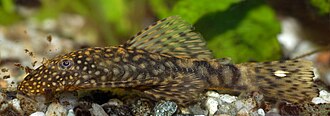
"My pleco won't eat" is one of the most common bristlenose questions, and in most cases the fish is eating perfectly well — just not when or what the owner expects. Bristlenose plecos (Ancistrus) are nocturnal grazers. Across the loricariid catfish family, the natural diet is detritus and algae,[1] scraped slowly from wood, stones and leaves, mostly at night. A bristlenose that hides all day and ignores the wafer dropped in at noon may have spent the previous night working over every surface in the tank.
Real loss of appetite does happen, and the causes are specific to how these fish live: a newly moved fish that has not settled, a male that has stopped feeding to guard eggs in his cave,[3] food that other fish take first, water that is too warm or too dirty, and less commonly parasites or infection. The quickest way to tell a fish that is eating unseen from one that is not eating at all is to look at what comes out the other end and at the shape of its belly. The steps below show how.
Why Is My Bristlenose Pleco Not Eating? The Common Causes
It Is Eating — at Night, and Mostly Grazing
Most LikelyA stable-isotope survey of 82 loricariid species found remarkably little variation from a generalised diet of detritus and algae.[1] In an established aquarium that food is everywhere: the biofilm on glass, wood, rocks and plant leaves, soft algae, and the fine organic debris that settles on the substrate. A bristlenose can live on this for days without touching anything you add, and it does most of its feeding after the lights go out. Rasping marks on driftwood and clean patches on the glass are signs of feeding, not boredom.
Many owners conclude the pleco is not eating because a wafer or vegetable slice is still there in the morning, or was taken by other fish. The better indicators are droppings — plecos produce a steady trail of them when feeding — and a gently rounded belly when the fish is seen from below on the glass. If both are present, the fish is eating.
A New Fish Settling In
Most LikelyIt is normal for a newly bought or moved bristlenose to eat little or nothing for the first few days. Handling, shipping and a new environment are recognised stressors,[4] and a fish that has not yet found a dark cave or crevice will spend its time hiding behind the filter or heater rather than feeding. Most start grazing within a week once they have claimed a hiding place.
What makes settling-in worse is a bare, brightly lit tank with no caves, a larger pleco that keeps evicting the newcomer, or fast, boisterous tankmates. Stress over longer periods weakens the immune system,[4] so a new fish that is still hiding and not feeding after two weeks should be looked at more closely.
A Male Guarding Eggs or Fry
PossibleIf the fish that has stopped eating is an adult male — long, branched bristles covering the snout — and he has not left his cave for days, check whether he is guarding a brood. Ancistrus males spawn in a cavity and then care for the eggs and fry alone, fanning the clutch with their fins, cleaning it and removing bad eggs, and guarding the fry for 7 to 10 days after hatching.[3] Aquarium accounts describe parental males that seldom leave the brood and either do not feed or feed only occasionally before hurrying back to the nest.[3]
Look into the cave with a torch: a cluster of large orange eggs on the ceiling, or tiny fry clinging to the walls, confirms it. The eggs hatch in 4 to 10 days depending on temperature, and from spawning to the fry leaving the nest the whole guarding period can last up to about three weeks.[3] The male will be thinner afterward but will resume normal feeding once the fry disperse. Do not remove him or the cave during this time.
Wrong Food or Food Stolen by Tankmates
PossibleA bristlenose may ignore food it does not recognise, especially hard, dry pellets or large pieces of raw vegetable, and young fish struggle with firm vegetables that have not been softened. In a community tank, faster fish such as tetras, barbs, cichlids or loaches may strip every wafer and slice long before the pleco finds it. The pleco then relies entirely on biofilm and algae, which may run out in a clean or heavily stocked tank.
Wood cannot make up the difference. In laboratory feeding trials, loricariids fed wood digested little of its cellulose, passed it through in under four hours and lost weight,[2] so a tank with driftwood but little algae or offered food can leave a bristlenose slowly starving even though it spends its nights rasping wood.
Water Too Warm, Poorly Oxygenated or Dirty
PossibleFish are cold-blooded, and all their physiological processes, including appetite and digestion, are strongly affected by water temperature.[6] Bristlenose do best at roughly 23–27 °C. In a tank running hotter than that — common in summer or with a heater stuck on — warm water holds less oxygen, and plecos may stop feeding and spend more time near the surface or filter outflow.
Ammonia and nitrite are the other common culprits. Low levels of ammonia cause stress and gill damage, fish exposed over time grow poorly and become more prone to bacterial infection, and the toxic fraction rises with pH and temperature.[5] Because it is invisible and odourless, testing is the only way to know it is there.[5] Water problems usually affect more than one fish at once.
Illness or Parasites
Less CommonLoss of appetite is one of the most common early signs of disease in fish, but it is rarely the only one. Some intestinal parasites cause affected fish to stop eating and lose weight,[9] and the flagellate Spironucleus, most often found in cichlids, is also frequently seen in the gut of some catfish; treatment is recommended when it comes with loss of condition.[7] Bacterial infections follow poor water quality and stress.[8]
Suspect illness when not eating comes with a sunken belly, pale or blotchy colour, laboured breathing, white patches, red streaks, clamped fins or a swollen body, or when the fish stops grazing entirely and sits in the open during the day.
How to Tell Why Your Bristlenose Isn't Eating
These checks take a day or two and do not need any medication. Most "not eating" bristlenose turn out to be eating normally.
-
Look for droppings
Check the substrate, the front glass and the area around the fish's favourite cave first thing in the morning. A pleco that is feeding leaves obvious droppings — often brown or green depending on what it has been grazing. Regular droppings mean food is going in, whatever you have seen.
-
Check the belly from underneath
When the fish rests on the front glass, look at its underside. A gently rounded belly means it is eating enough. A flat or concave belly, with a thin area behind the head, means it is not getting enough food and needs action.
-
Watch after lights-out
Wait 30–60 minutes after the tank lights go off and look with a dim torch or room light. Bristlenose are most active then, and you will usually see the fish grazing on the glass, wood and plants. Drop a piece of blanched courgette or an algae wafer in at this time and see whether it finds it before other fish do.[1]
-
Check its cave for eggs or fry
If the fish is a male with long bristles and has not left his cave for days, shine a torch inside. Orange eggs on the cave roof or fry clinging to the walls mean he is guarding a brood and fasting is normal.[3]
What to Do for a Bristlenose That Isn't Eating
-
Feed at night and target the pleco
Offer food after lights-out, placed close to the pleco's cave, so it reaches the food before the other fish. Good options are blanched courgette (zucchini), cucumber, shelled peas, green beans or spinach, weighted down with a plant weight or fork, plus algae wafers a few times a week. For juveniles, soften vegetables well. Leave vegetables in overnight and remove leftovers in the morning.
-
Give it caves and time to settle
Provide at least one cave or tube per bristlenose, plus driftwood and some shaded areas. A new fish usually starts feeding within a week once it has a safe place. Avoid moving decor around or netting the fish repeatedly, since handling is itself a stressor.[4]
-
Correct the water
If ammonia or nitrite is detectable, do a partial water change with dechlorinated water at the same temperature and cut back feeding for the rest of the tank until the filter catches up. If the tank is too warm, lower the heater setting and increase surface agitation for oxygen. Retest daily until the readings are stable.[5]
-
Leave a guarding male alone
A male tending eggs or fry should not be moved or disturbed. Keep the lights low near his cave, keep feeding the tank normally so food is available when he emerges, and expect him to eat again once the fry leave the cave, up to about three weeks after spawning.[3]
-
If it is ill, get a diagnosis
If not eating comes with other signs of disease, isolate the fish in a hospital tank with a cave and clean water at the same temperature. Ask an aquatic vet to examine droppings or skin samples before treating; intestinal parasites and bacterial infections each need different medication, and antibiotic choice should be based on testing where possible.[7][8] Follow the vet's instructions or the product label exactly.
Keeping a Bristlenose Feeding Well
When a Bristlenose That Isn't Eating Needs Help
🔬 AI Symptom Checker
Not sure what's wrong? Describe your fish's symptoms to the FishCare AI symptom checker for a second opinion before you treat.
Check Symptoms →Frequently Asked Questions
How long can a bristlenose pleco go without eating?
My bristlenose ignores algae wafers. What else can I feed it?
Can a bristlenose live on driftwood alone?
Why is my male bristlenose hiding and not eating?
My new bristlenose hasn't eaten since I bought it. Is that normal?
This guide was researched against the veterinary and scientific sources listed below and reviewed for biological accuracy. Test water parameters before treating a sick fish, and consult an aquatic veterinarian if symptoms persist after 48 hours of correct treatment.
References
- Lujan, N.K., Winemiller, K.O. & Armbruster, J.W. (2012). Trophic diversity in the evolution and community assembly of loricariid catfishes. BMC Evolutionary Biology 12: 124. doi:10.1186/1471-2148-12-124
- German, D.P. (2009). Inside the guts of wood-eating catfishes: can they digest wood? Journal of Comparative Physiology B 179(8): 1011–1023. doi:10.1007/s00360-009-0381-1
- Sabaj, M.H., Armbruster, J.W. & Page, L.M. (1999). Spawning in Ancistrus (Siluriformes: Loricariidae) with comments on the evolution of snout tentacles as a novel reproductive strategy: larval mimicry. Ichthyological Exploration of Freshwaters 10(3): 217–229. auburn.edu (PDF)
- Francis-Floyd, R. Stress — Its Role in Fish Disease. UF/IFAS Extension, Circular 919 (FA005). ask.ifas.ufl.edu
- Francis-Floyd, R., Watson, C., Petty, D. & Pouder, D.B. Ammonia in Aquatic Systems. UF/IFAS Extension, FA16 (FA031). ask.ifas.ufl.edu
- Merck Veterinary Manual. Management of Aquarium Fish. Merck & Co., Inc. merckvetmanual.com
- Merck Veterinary Manual. Parasitic Diseases of Fish. Merck & Co., Inc. merckvetmanual.com
- Merck Veterinary Manual. Bacterial Diseases of Fish. Merck & Co., Inc. merckvetmanual.com
- Merck Veterinary Manual. Disorders and Diseases of Fish. Merck & Co., Inc. merckvetmanual.com