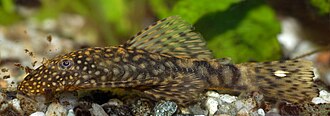
A bristlenose pleco (Ancistrus) that suddenly looks round underneath is a common worry, and the generic advice — dropsy, parasites, medicate — skips the two things that explain most cases. The first is food. In the wild, loricariid catfishes live on a fairly narrow diet of detritus and algae,[2] and even the famous wood-eating plecos turn out to be detritivores rather than true wood digesters.[3] An aquarium bristlenose that fills up every night on protein-rich wafers, sinking pellets and leftovers meant for other fish will look bloated for the same reason any overfed fish does.
The second is eggs. Ancistrus are cave spawners: the male claims a dark cavity, the female lays a clump of 20 to 200 adhesive eggs, each two to three millimetres across, and then leaves the male to guard them.[1] Eggs that size make a ripe female visibly broad across the belly for days or weeks before she spawns. Once food and eggs are ruled out, the remaining causes — bacterial infection with fluid in the body cavity, intestinal parasites and, rarely, tumours — are less likely but more serious. The checks below take a few minutes and tell them apart.
Why Is My Bristlenose Pleco Bloated? The Common Causes
Overfeeding and a Diet Too Rich for a Grazer
Most LikelyThis is the most common cause in both sexes. A stable-isotope study of 82 loricariid species across South America found that despite their varied jaws, the family shows little variation from a generalised diet of detritus and algae, feeding at a similar, low trophic level.[2] A bristlenose is built to scrape biofilm, soft algae and decaying plant matter slowly and continuously. In an aquarium it is often given dense algae wafers or catfish pellets every night on top of the flakes and pellets that sink from feeding the other fish — far more concentrated food than it would ever find on a submerged log.
Bloat from food shows a clear pattern. The belly is evenly rounded, it is largest in the morning after a night of feeding, the fish is still active and grazing, and droppings are thick and plentiful or, if it is constipated, sparse. Often more than one pleco in the tank looks the same. It goes down after two or three days of reduced feeding. Driftwood is not the cause: in feeding trials, plecos passed stained wood through their gut in less than four hours and digested little of its cellulose,[3] so wood rasping adds fibre and bulk rather than trapped food.
A Female Carrying Eggs
Most LikelyIn an adult female a full, rounded belly is often simply a clutch of eggs developing in the ovaries. Ancistrus eggs are unusually large for the size of the fish, about 2 to 3.2 mm in diameter and yellowish-orange, and a female releases them in batches in the male's cave until she has laid them all.[1] A female carrying a full clutch looks broad and slightly squared-off when seen from above, and the swelling sits low and toward the rear of the belly. She keeps grazing and moving normally.
Sexing is straightforward in adults. Mature males carry the elaborate fleshy tentacles on the snout that give the fish its name, and they are best developed in breeding males; females have only small tentacles along the edge of the snout or none at all.[1] If your round fish is a female, there is a male in the tank and he is defending a cave, pipe or the space under a piece of wood, the most likely outcome is that she spawns there in the coming days and returns to a normal shape overnight. A female with no male or no suitable cave may stay round for longer; if she remains active and eating, that is not in itself an emergency.
Dropsy From Bacterial Infection
PossibleDropsy is fluid collecting in the body cavity, and it is a sign rather than a single disease.[4] In most fish it is recognised by scales lifting outward like a pinecone. Plecos are covered in bony plates rather than overlapping scales, so that classic sign is hard to see; instead look for a soft belly that has become tight, stretched and shiny, often with bulging eyes, reddening around the vent or fins, and a fish that has stopped grazing and sits in the open.
Bacterial disease outbreaks in aquarium fish are frequently associated with poor water quality and organic loading,[5] and ammonia exposure makes fish more susceptible to bacterial infections.[7] A bristlenose with dropsy is therefore also a warning about the tank. By the time the belly is visibly distended with fluid the internal damage is usually advanced, and many fish do not recover even with treatment.
Intestinal Parasites
Less CommonMost bristlenose sold today are captive-bred, which makes heavy parasite burdens less common than in wild-caught plecos, but they do occur. The flagellate Spironucleus is most often found in cichlids but is also frequently seen in the intestinal tract of gouramis and some catfish, and treatment is recommended when it is associated with loss of condition.[6] Intestinal roundworms such as Camallanus, which show as red threads at the vent, can also infect aquarium fish.[6]
The picture that suggests parasites is a swollen or uneven belly together with thinning along the back and behind the head, stringy or pale droppings, and a fish that eats but does not hold its weight — especially in a recently bought fish or a tank where new fish were added without quarantine. Parasites are diagnosed by examining droppings or gut contents under a microscope, which an aquatic vet can do.
Tumours and Chronic Infection
Less CommonIn older fish, a slowly enlarging abdomen that does not change with feeding can be a tumour. Reproductive tumours are well described in other ornamental species, where affected fish have a swollen abdomen and gradually lose body condition,[4] and the swelling is often lopsided rather than even. Mycobacteriosis (fish TB) can also cause fluid in the abdomen together with emaciation and pale colour; there is no effective treatment that eliminates it in fish, and it can infect people through cuts on the hands.[5] Both are uncommon explanations for a bloated bristlenose and are usually considered only when the swelling persists for weeks or fish are wasting one after another.
How to Tell Why Your Bristlenose Is Bloated
Work through these checks in order. Most bloated bristlenose plecos are explained by the first three, and none of them requires medication.
-
Sex the fish by its bristles
Look at the snout from above. A mature male has long, fleshy, often branched tentacles over the snout and up toward the forehead; a female has short tentacles only around the snout margin, or none.[1] Juveniles of both sexes look similar and are not yet carrying eggs. If it is a female, keep egg-bearing on the list; if it is a male, move on.
-
Look at the belly from below and from above
Bristlenose often rest on the glass, so you can see the underside easily. An evenly rounded, soft-looking belly in an active fish is typical of food or eggs; a belly carrying eggs tends to sit toward the rear and look broad from above. A belly that is tight, glossy and stretched, with bulging eyes or red streaks around the vent or fins, suggests fluid — that is the dropsy picture and moves you to the treatment section today.[4]
-
Check feeding and droppings
Add up everything that reaches the bottom of the tank in a day: pleco wafers, sinking pellets, and the food the other fish miss. Then look for droppings on the substrate. Plenty of thick droppings and a round belly usually mean overfeeding. Few or no droppings in a fish that is still eating suggests constipation. Long, pale, stringy droppings with weight loss along the back point toward parasites.[6]
-
Test the water
Test ammonia, nitrite, nitrate, pH and temperature. Ammonia is colourless and odourless even at toxic levels, so testing is the only way to know it is there,[7] and fish exposed to low levels over time are more prone to bacterial infection. Bristlenose are comfortable at roughly 23–27 °C with pH around 6.5–7.5; any ammonia or nitrite reading above zero means the tank needs attention before anything else.
Recommended: Water test kit -
Feed nothing for two to three days and watch
A healthy adult bristlenose will graze biofilm and algae in the meantime and comes to no harm from a short fast. A belly that shrinks was food. A female who stays round but active and then suddenly slims down has probably spawned — check the male's cave for a cluster of orange eggs. A belly that stays the same or grows, especially with lethargy or weight loss elsewhere, needs the disease causes taken seriously.
What to Do for a Bloated Bristlenose Pleco
-
If it is food: fast, then change the diet
Stop feeding for two to three days, then feed small amounts after the lights go out, when bristlenose do most of their feeding. Make vegetables the base of the diet — blanched courgette (zucchini), cucumber, shelled peas, green beans or spinach — with algae wafers as a supplement a few times a week rather than every night. Keep a piece of driftwood in the tank for grazing and cover, but do not rely on it as food: plecos cannot live on wood itself.[3]
-
If she is carrying eggs: give the pair a cave
A ripe female needs no treatment. Provide at least one cave per male — a pleco cave, a length of clay pipe or a gap under a flat stone or wood — in a dim part of the tank. The male will clean it, lead the female in, and guard the eggs and fry for up to ten days after hatching.[1] If you do not want fry, simply leave the eggs to the other fish; the female will slim down either way.
-
If the belly is tight and the fish is sick: isolate and fix the water
Move the fish to a hospital tank with clean, dechlorinated water at the same temperature, with a cave or tube to hide in, and correct the main tank with partial water changes. Stress from poor water quality, crowding and handling weakens the immune system,[8] so reducing it matters as much as any medicine. Antibiotic choice should ideally be based on culture and sensitivity testing,[5] which an aquatic vet can arrange; guessing with shop antibiotics is often ineffective. Be honest about the outlook once fluid has built up.
-
If parasites are suspected: get a diagnosis before dosing
Ask an aquatic vet or experienced fish health service to examine fresh droppings. Metronidazole is the treatment used for Spironucleus, and fenbendazole or levamisole for intestinal worms such as Camallanus;[6] the dose and schedule depend on the product and the diagnosis, so follow the vet's instructions or the product label exactly. Treat all fish that share the tank, and vacuum the substrate thoroughly afterward.
Preventing Bloating in Bristlenose Plecos
When a Bloated Bristlenose Needs Expert Help
🔬 AI Symptom Checker
Not sure what's wrong? Describe your fish's symptoms to the FishCare AI symptom checker for a second opinion before you treat.
Check Symptoms →Frequently Asked Questions
Is my bristlenose pleco pregnant?
Why is my male bristlenose bloated?
Can driftwood make my pleco bloated?
Do peas help a bloated pleco?
How long can a bristlenose go without food?
Is a bloated pleco contagious to my other fish?
This guide was researched against the veterinary and scientific sources listed below and reviewed for biological accuracy. Test water parameters before treating a sick fish, and consult an aquatic veterinarian if symptoms persist after 48 hours of correct treatment.
References
- Sabaj, M.H., Armbruster, J.W. & Page, L.M. (1999). Spawning in Ancistrus (Siluriformes: Loricariidae) with comments on the evolution of snout tentacles as a novel reproductive strategy: larval mimicry. Ichthyological Exploration of Freshwaters 10(3): 217–229. auburn.edu (PDF)
- Lujan, N.K., Winemiller, K.O. & Armbruster, J.W. (2012). Trophic diversity in the evolution and community assembly of loricariid catfishes. BMC Evolutionary Biology 12: 124. doi:10.1186/1471-2148-12-124
- German, D.P. (2009). Inside the guts of wood-eating catfishes: can they digest wood? Journal of Comparative Physiology B 179(8): 1011–1023. doi:10.1007/s00360-009-0381-1
- Merck Veterinary Manual. Disorders and Diseases of Fish. Merck & Co., Inc. merckvetmanual.com
- Merck Veterinary Manual. Bacterial Diseases of Fish. Merck & Co., Inc. merckvetmanual.com
- Merck Veterinary Manual. Parasitic Diseases of Fish. Merck & Co., Inc. merckvetmanual.com
- Francis-Floyd, R., Watson, C., Petty, D. & Pouder, D.B. Ammonia in Aquatic Systems. UF/IFAS Extension, FA16 (FA031). ask.ifas.ufl.edu
- Francis-Floyd, R. Stress — Its Role in Fish Disease. UF/IFAS Extension, Circular 919 (FA005). ask.ifas.ufl.edu
- Merck Veterinary Manual. Management of Aquarium Fish. Merck & Co., Inc. merckvetmanual.com