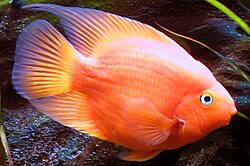
Few things look as alarming as a blood parrot tilting, drifting head-down or floating on its side at the surface. The blood parrot is a man-made hybrid, usually of the Midas cichlid Amphilophus citrinellus and Vieja melanura, and the rounded body, beak-shaped mouth that cannot fully close and compressed skeleton that make it popular come from that hybridisation. A study describing the hybrid notes that some offspring have deformities, including a damaged swim bladder that distorts their swimming.[1] Blood parrots start out with less margin for buoyancy control than ordinary cichlids.
That is why sideways swimming in this fish is so often a buoyancy problem rather than a sign of imminent death. But buoyancy is a symptom, not a disease: the swim bladder can be pushed out of balance by a full or gassy gut, compressed by swelling or a growth, or damaged by infection.[2] Poisoning from ammonia or nitrite can make a fish lose its balance too. The checks below separate these in about an hour, and the most important one is a water test.
Why Is My Blood Parrot Swimming Sideways? The Common Causes
Buoyancy Problem Linked to the Hybrid Body
Most LikelyThe swim bladder is the gas-filled organ that lets a fish hover without effort. Cichlids have a closed swim bladder, filled and emptied through the blood rather than by gulping air, so the amount of gas is regulated slowly. In a blood parrot, the organ sits inside a body that has been shortened and rounded by breeding, and some hybrid offspring have damaged swim bladders that impair swimming.[1]
There are two patterns. A fish that has always swum slightly oddly, with a permanent tilt but normal appetite and energy, probably has a structural problem it was born with; it is usually manageable but will not be cured. A fish that swam normally and has lost control in the last day or two has had something push its buoyancy out of balance — most often the gut, the water or an infection, covered below. Veterinary work on buoyancy disorders uses X-rays or ultrasound to see whether the swim bladder is fluid-filled, deformed or compressed by something else.[2]
Overfeeding, Constipation and Gas
Most LikelyA distended stomach and intestine press on the swim bladder, and blood parrots are enthusiastic eaters that are often fed floating pellets several times a day. Because the malformed mouth makes them slow, awkward feeders,[1] they also tend to take in air with food at the surface. The typical result is a fish that tips forward or rolls onto its side shortly after meals, with a rounded belly, and improves after a day or two without food.
Improper nutrition is one of the most common contributors to illness in aquarium fish,[3] and a diet of dry pellets alone makes constipation more likely. The clues are timing (worse after feeding), a full belly with little or no faeces, and a fish that is otherwise alert with good colour. This is the most treatable cause, and fasting is both a test and a treatment.
Poor Water Quality or Poisoning
PossibleLoss of balance is one of the ways fish react to toxic water. Ammonia at low concentrations stresses fish and damages the gills, and at higher concentrations it kills them.[4] The Merck Veterinary Manual lists ammonia toxicity among the causes of nervous-system signs in fish, and describes "new tank syndrome" — ammonia building up because the biological filter is not yet established — as usually striking one to three weeks after a new system is set up.[3] Nitrite, low oxygen, a failed heater or a sudden temperature or pH change can have similar effects.
Suspect the water when the problem started suddenly, when more than one fish is gasping, lethargic or off balance, or when the tank is new, recently cleaned very thoroughly, overstocked or heavily fed. This cause can kill quickly, which is why a water test comes before anything else.
Bacterial Infection
PossibleInfection can upset balance in two ways. It can damage the swim bladder directly: in a veterinary series of swim bladder disorders in pond fish, bacteria including Aeromonas were isolated from affected swim bladders.[2] Or it can affect the whole body and the nervous system. UF/IFAS lists erratic swimming such as spiralling or spinning, loss of buoyancy control, lethargy, darkening and bulging or cloudy eyes among the signs of streptococcal infection, and cichlids are among the susceptible fish.[5] The Merck Veterinary Manual describes spinning or spiralling in the water as a characteristic sign of Streptococcus.[6]
The difference from a simple buoyancy problem is the company the sideways swimming keeps: loss of appetite, dark colour, red streaks or patches, bloating with raised scales, cloudy or bulging eyes, or a fish that spins rather than just tilts. Bacterial outbreaks are usually triggered by poor water, organic loading, handling, temperature changes or low oxygen,[6] and they need a diagnosis and prescription treatment.
Resting, Stress or Bullying
Less CommonNot every blood parrot on its side is ill. Many keepers see their parrots rest wedged in caves or leaning against decor, especially at night or after being moved, and a newly introduced fish can sulk on the bottom for a day or two. The distinguishing feature is that the fish rights itself and swims normally as soon as it is disturbed or food appears.
A fish that is being chased and nipped by tank mates may also hide at odd angles in corners or at the surface. Aggression from other fish is a recognised source of stress, and chronic stress lowers disease resistance,[7] so a bullied blood parrot can move from this cause to one of the others. Look for torn fins and a tank mate that patrols the fish's hiding place.
Internal Swelling, Growths or Old Age
Less CommonAnything that takes up space in the body cavity can displace or squash the swim bladder: fluid build-up (dropsy), enlarged organs, egg masses or tumours. In the veterinary swim bladder series, one fish's swim bladder was compressed by a tumour of the reproductive organ.[2] These causes develop over weeks, often with a lopsided or swollen belly, and are more likely in older fish.
They cannot be diagnosed by eye; imaging by an aquatic vet is the only way to know.[2] Where the cause is a growth or chronic organ failure, the honest goal is comfort rather than cure.
How to Tell Why Your Blood Parrot Is Swimming Sideways
Do the water test first, because it rules out the cause that kills fastest. The rest takes an hour of watching and one or two days of fasting.
-
Test the water immediately
Test ammonia, nitrite, nitrate, pH and temperature. In an established tank ammonia and nitrite should both be zero; any reading means the fish may be poisoned rather than simply off balance.[4][3] Blood parrots do best at 24–28 °C and pH 6.5–7.5. Check whether other fish are also gasping or lethargic.
Recommended: Water test kit -
Tap the glass or offer food: does it right itself?
A resting or sulking fish swims off normally when disturbed. A fish with a buoyancy problem struggles: it floats back up, sinks back down, or tips over again as soon as it stops swimming. A fish that spins or corkscrews rather than tilting points towards infection or a nervous-system problem.[5][6]
-
Note whether it floats or sinks, and when
Record whether the fish is stuck at the surface, lying on the bottom or tilting mid-water, and whether it is worse after meals. Floating or tipping forward after feeding points to the gut. A permanent, unchanging tilt in a fish that has always swum a little oddly suggests a structural problem from its hybrid body.[1]
-
Look at the belly and the whole fish
Look from above for raised scales (dropsy) and a lopsided swelling, and check for red streaks, darkening, cloudy or bulging eyes, torn fins and faeces. A full, round belly with no other signs points to feeding; the other signs point to infection, swelling or bullying.[5]
-
Fast the fish for two to three days
Withhold food for 48 to 72 hours and watch. A blood parrot whose balance returns as its belly shrinks had a gut-related problem. One that does not improve, or gets worse, needs a vet — bring a live fish in a container with a battery aerator and at least 500 mL of tank water for testing, as vets recommend.[8]
What to Do for a Blood Parrot Swimming Sideways
-
If the water is bad: fix it first
Do a partial water change with dechlorinated, temperature-matched water and repeat daily until ammonia and nitrite read zero. Stop or cut feeding while the filter catches up, and do not strip or replace all the filter media. Add aeration. These steps come before any other treatment, because ammonia stress also makes bacterial infection more likely.[4]
-
If it is gut-related: fast, then change how you feed
After the fast, feed small portions of sinking food once or twice a day, soaked in tank water first so it expands before it is swallowed. Add variety such as thawed frozen foods rather than feeding dry pellets alone.[3] Blanched, shelled peas are a popular hobby remedy; evidence for them is anecdotal, but they are harmless as an occasional food. Keep the temperature steady in the upper part of the 24–28 °C range, which helps digestion.
-
Make life easier for a fish that stays tilted
A blood parrot with a permanent buoyancy problem can live well with help. Lower the water level or use a shallow hospital tank, reduce strong flow, and make sure it can reach food easily without competition. Watch for sores on the side that faces the surface or the substrate. Structural problems from the hybrid body are managed, not cured.[1]
-
If infection is likely: isolate and get a diagnosis
Move the fish to a hospital tank with clean water, keep the main tank's water good, and contact an aquatic veterinarian. Bacterial infections should be confirmed by culture, and sensitivity testing is recommended before antibiotics are used.[6] Streptococcal infections of cichlids respond to specific prescription antibiotics.[5] Be realistic: in the veterinary swim bladder series, only three of nine koi recovered after treatment and the rest were euthanised.[2] Streptococcus iniae can infect people through wounds, so wear gloves if you have cuts on your hands.[6]
-
Reduce stress while it recovers
Separate the fish from any tank mate that harasses it, dim the lights, and avoid repeated netting. Stress suppresses the immune system and slows recovery from any of these causes.[7]
Preventing Buoyancy Problems in Blood Parrots
When a Blood Parrot Needs Urgent Help
🔬 AI Symptom Checker
Not sure what's wrong? Describe your fish's symptoms to the FishCare AI symptom checker for a second opinion before you treat.
Check Symptoms →Frequently Asked Questions
Is it normal for blood parrots to swim sideways?
Can a blood parrot recover from swim bladder disease?
Why is my blood parrot upside down but still alive?
Do peas help a blood parrot with swim bladder problems?
Why is my blood parrot lying on its side at the bottom?
Is swim bladder disease contagious?
This guide was researched against the veterinary and scientific sources listed below and reviewed for biological accuracy. Test water parameters before treating a sick fish, and consult an aquatic veterinarian if symptoms persist after 48 hours of correct treatment.
References
- Aqmal-Naser, M. & Ahmad, A. (2020). First report of the hybrid blood parrot cichlid from a rice agroecosystem in Seberang Perai Tengah, Penang, Peninsular Malaysia, with notes on syntopic Midas cichlid, Amphilophus citrinellus (Günther, 1864). BioInvasions Records 9(3): 588–598. doi:10.3391/bir.2020.9.3.15
- Sirri, R., Mandrioli, L., Zamparo, S. et al. (2020). Swim Bladder Disorders in Koi Carp (Cyprinus carpio). Animals 10(11): 1974. doi:10.3390/ani10111974
- Merck Veterinary Manual. Disorders and Diseases of Fish. Merck & Co., Inc. merckvetmanual.com
- Francis-Floyd, R., Watson, C., Petty, D. & Pouder, D.B. (2022). Ammonia in Aquatic Systems. UF/IFAS Extension, FA16 (FA031). doi:10.32473/edis-fa031-2022
- Yanong, R.P.E. & Francis-Floyd, R. Streptococcal Infections of Fish. UF/IFAS Extension, Circular 57 (FA057). ask.ifas.ufl.edu
- Merck Veterinary Manual. Bacterial Diseases of Fish. Merck & Co., Inc. merckvetmanual.com
- Francis-Floyd, R. Stress—Its Role in Fish Disease. UF/IFAS Extension, Circular 919 (FA005). ask.ifas.ufl.edu
- Merck Veterinary Manual. Management of Aquarium Fish. Merck & Co., Inc. merckvetmanual.com