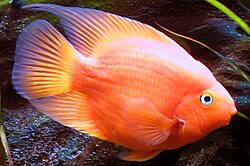
Blood parrots are sold on their colour, and the orange-red fish in the shop tank is often not the fish you will have six months later. The blood parrot is a hybrid, generally reported as a cross between a bright orange colour morph of the Midas cichlid and Vieja melanura, and fish that lack the bright orange preferred in the trade are less valued.[1] That commercial pressure is why so many blood parrots are coloured up before sale — by diet, by hormones, or by dye injected under the skin — and why "my parrot is losing its colour" is one of the most common questions new owners ask.[2]
The question to answer is which colour is going and how fast. Orange fading slowly to peach or yellow in a new fish usually means it has come off a colour-enhancing diet.[2][3] Blue, purple, green or pink disappearing in patches means dye wearing off.[2] Black patches breaking up on a young fish is its normal juvenile colour development.[4] Colour that switches off within minutes or hours is stress. Only a minority of cases are disease, and those come with other signs. If your parrot's problem is an overall washed-out, pale look in a fish you have had for a long time, the diet, water and stress sections below matter most.
Why Is My Blood Parrot Losing Colour? The Common Causes
Shop Colour Wearing Off (Colour-Enhancing Food)
Most LikelyA blood parrot's orange and red come from carotenoid pigments in its food, and farms and shops can intensify them by feeding carotenoid-rich diets. The effect is strong but not permanent. In a six-week trial on blood parrots, skin pigmentation rose significantly as dietary canthaxanthin was increased, up to a point beyond which extra pigment gave no further gain.[3] A review of the ornamental trade notes the other half of the story: the effect of colour-enhancing foods is temporary, and once fish are no longer fed them, they eventually lose the colour.[2]
This is the usual explanation when a newly bought fish goes from deep orange-red to lighter orange, peach or yellow over its first weeks to months, evenly over the whole body, while eating and behaving normally. The fish is not ill; it is settling to what its home diet can support. Some fish have also been treated with hormones to intensify their colour, and that colour may last only a few weeks before the fish fades markedly.[2] A good carotenoid diet will bring back some colour, but it may never match the shop tank.
Dye Fading from an Artificially Coloured Fish
Most LikelyParrot fish are among the species most often artificially coloured. A review of the practice describes dye being injected under the skin with needles, sometimes producing an all-over colour and sometimes little pockets of dye, and states that the dye eventually fades within six to ten months.[2] Blood parrots are also sold tattooed with symbols or patterns. Fish sold as blue, purple, green or pink parrots, "jellybean" or "candy" parrots, or with hearts and characters on their flanks have been coloured this way; blood parrots do not produce these colours naturally.
Dye loss looks different from dietary fading: the unnatural colour shrinks or blotches rather than dulling evenly, and it leaves the fish's own pale cream, peach or orange underneath. It cannot be reversed, and the fish is not ill because of the fading itself. The same review notes that dyeing and injection are stressful, with high mortality in the weeks after the procedure and an increased risk of disease,[2] so a newly bought dyed fish deserves extra attention to water quality and signs of infection.
Juvenile Colour Development: Black Patches Clearing
PossibleYoung blood parrots do not start orange. Research on the hybrid explains that its red appearance develops after its initial black colouring fades, around three weeks after hatching, but that some juveniles keep black or mottled skin; the study compared the skin of "fading" and "non-fading" fish and linked the difference to melanin-pathway genes.[4] Small parrots in shops can still be blotched with black, grey or brown, and those patches often continue to break up and disappear as the fish grows.
One of the blood parrot's parents is the Midas cichlid, in which some individuals lose their black pigment cells during life and turn gold as those cells die.[5] A parrot whose black smudges are retreating to reveal orange is therefore not losing colour in any worrying sense; it is gaining its adult colour. The change is one-way and needs no treatment. The opposite pattern — orange giving way to new dark patches — is more often stress, covered next.
Stress Colour and Dark Bars
PossibleFish change colour physiologically within minutes to hours. The melanocortin hormone system controls whether dark pigment is spread through the skin cells or pulled together, and its activation darkens the fish.[6] Blood parrots use this visibly: a frightened, newly moved or bullied parrot may turn pale overall, or develop dark blotches or vertical bars on an otherwise orange body. Background also matters; a cichlid study found fish darkened on black backgrounds and experienced them as more stressful than grey or white ones.[7]
Stress colour comes with a trigger — a new tank, a move, rearranged decor, a new or aggressive tank mate, a breeding pair claiming territory — and fades within hours to days once the trigger is removed. Because of their small, beak-shaped mouths, blood parrots are awkward feeders[1] and often lose out to faster fish, which adds chronic stress. Stress that continues suppresses immunity and increases the risk of disease.[8]
Poor Water, Disease or Age
Less CommonWater problems and illness dull a blood parrot, but they almost never do so on their own. Ammonia at low concentrations stresses fish and damages the gills, and fish exposed over time are more susceptible to bacterial infections.[9] Chronic bacterial disease such as mycobacteriosis causes paleness along with emaciation, skin ulcers and bulging eyes, and outbreaks are generally triggered by poor water, handling, temperature swings or low oxygen.[10] A sick parrot will also be clamping its fins, hiding, breathing faster or refusing food.
Blood parrots can live for many years, and an old fish may slowly lose some intensity. That fading takes years, is even over the body, and happens in a fish that is otherwise normal. If the colour change began in the last few weeks, age is not the explanation.
How to Tell Why Your Blood Parrot Is Losing Colour
Answer these in order. Most blood parrots are explained by the first three, and none of the checks requires medication.
-
Work out how long you have had the fish
A fish that started fading within weeks to a few months of purchase is most likely losing shop colour — colour food, hormones or dye.[2] A fish that was stable for a year or more and then changed has a cause in your tank: diet, stress, water or illness. Look back at photos from when you bought it.
-
Identify which colour is disappearing
Blue, purple, green, pink, or a pattern or symbol, fading in patches: dye.[2] Black or grey patches shrinking to reveal orange on a young fish: normal juvenile development.[4] Orange fading evenly to peach or yellow: diet.[3] Orange replaced by dark bars or blotches, or the whole fish pale, that comes and goes: stress.[6]
-
Watch how fast the colour changes
Photograph both sides under the same light every few days. Stress colour can change within the same day, and often lifts when the fish is left alone.[6] Dietary and dye fading are slow and steady. Juvenile black loss moves in one direction only.
-
Test the water and check for illness
Test ammonia, nitrite, nitrate, pH and temperature; ammonia and nitrite should read zero.[9] Blood parrots do best at 24–28 °C and pH 6.5–7.5. Then check for clamped fins, sores, frayed fins, white spots, cloudy or bulging eyes, a thin back and refusal to eat. Any of these makes disease more likely than simple colour loss.[10]
Recommended: Water test kit
What to Do When a Blood Parrot Is Losing Colour
-
If it is shop colour or dye: accept the fish's own colour
Neither dye nor hormone-boosted colour can be restored, and trying to chase it with supplements does not work.[2] Give the fish good water and a good diet so its natural colour is as strong as it can be, and watch a recently dyed fish closely for infection, since the procedure itself raises disease risk.[2] Avoid buying dyed or tattooed fish in future; demand is what keeps the practice going.
-
Feed a carotenoid-rich staple
Choose a small, sinking pellet sized for the parrot's mouth that lists a real carotenoid source such as krill, shrimp, astaxanthin or canthaxanthin, and add frozen krill or mysis. In the blood parrot trial, colour improved over six weeks of feeding, and adding more pigment beyond the optimum gave no further benefit,[3] so a good food fed consistently beats doses of colour enhancer. Allow at least four to six weeks before judging.
-
Remove the source of stress
Rehome or separate aggressive tank mates, add caves and decor that break sight lines, avoid black backgrounds and bare tanks,[7] and feed in a way that lets the parrot get its share. Stress colour usually lifts within days once the cause is really gone; if it does not, look again at the water and the tank mates.[8]
-
Correct water and temperature
If ammonia or nitrite is detectable, do a partial water change with dechlorinated, temperature-matched water, reduce feeding and check that the filter is adequate.[9] Keep the temperature stable at 24–28 °C. Good water will not bring back dye or shop colour, but it prevents the chronic stress that turns a colour change into disease.
-
Get a diagnosis if other symptoms appear
If colour loss comes with poor appetite, sores, fin damage, cloudy eyes or weight loss, contact an aquatic veterinarian. Bacterial infections should be identified by culture, and sensitivity testing is recommended before choosing an antibiotic.[10] Do not medicate a fish for colour loss alone.
Keeping a Blood Parrot's Colour
When a Blood Parrot Losing Colour Needs Help
🔬 AI Symptom Checker
Not sure what's wrong? Describe your fish's symptoms to the FishCare AI symptom checker for a second opinion before you treat.
Check Symptoms →Frequently Asked Questions
Why is my blood parrot turning white or yellow?
Will my blood parrot get its colour back?
How can I tell if my blood parrot was dyed?
Why is my baby blood parrot black?
Why does my blood parrot have black spots or bars?
What is the best food for blood parrot colour?
This guide was researched against the veterinary and scientific sources listed below and reviewed for biological accuracy. Test water parameters before treating a sick fish, and consult an aquatic veterinarian if symptoms persist after 48 hours of correct treatment.
References
- Aqmal-Naser, M. & Ahmad, A. (2020). First report of the hybrid blood parrot cichlid from a rice agroecosystem in Seberang Perai Tengah, Penang, Peninsular Malaysia, with notes on syntopic Midas cichlid, Amphilophus citrinellus (Günther, 1864). BioInvasions Records 9(3): 588–598. doi:10.3391/bir.2020.9.3.15
- Eşanu, V.O., Gavriloaie, C., Oroian, I.G. & Burny, P. (2015). Some considerations concerning the artificially colored aquarium fish trade. AACL Bioflux 8(1): 116–121. bioflux.com.ro
- Li, M., Rahman, M.M., Wu, B. & Lin, Y.-C. (2017). Effects of dietary canthaxanthin on growth and body colour of blood parrot cichlid Amphilophus citrinellus × Paraneetroplus synspilus. Aquaculture International 25(2): 705–713. doi:10.1007/s10499-016-0068-z
- Li, C., Zhang, X., Meng, Y., Bai, X., Liu, X., Ma, L., Wu, H. & Jiang, J. (2025). Melanin pathway genes drive skin color divergence in juvenile blood parrot cichlid hybrids. Academia Molecular Biology and Genomics 2(3). doi:10.20935/acadmolbiogen7803
- Kratochwil, C.F., Kautt, A.F., Nater, A., Härer, A., Liang, Y., Henning, F. & Meyer, A. (2022). An intronic transposon insertion associates with a trans-species color polymorphism in Midas cichlid fishes. Nature Communications 13: 296. doi:10.1038/s41467-021-27685-8
- Cal, L., Suarez-Bregua, P., Cerdá-Reverter, J.M., Braasch, I. & Rotllant, J. (2017). Fish pigmentation and the melanocortin system. Comparative Biochemistry and Physiology Part A 211: 26–33. doi:10.1016/j.cbpa.2017.06.001
- van der Salm, A.L., Spanings, F.A.T., Gresnigt, R., Wendelaar Bonga, S.E. & Flik, G. (2005). Background adaptation and water acidification affect pigmentation and stress physiology of tilapia, Oreochromis mossambicus. General and Comparative Endocrinology 144(1): 51–59. doi:10.1016/j.ygcen.2005.04.017
- Francis-Floyd, R. Stress—Its Role in Fish Disease. UF/IFAS Extension, Circular 919 (FA005). ask.ifas.ufl.edu
- Francis-Floyd, R., Watson, C., Petty, D. & Pouder, D.B. (2022). Ammonia in Aquatic Systems. UF/IFAS Extension, FA16 (FA031). doi:10.32473/edis-fa031-2022
- Merck Veterinary Manual. Bacterial Diseases of Fish. Merck & Co., Inc. merckvetmanual.com
- Merck Veterinary Manual. Management of Aquarium Fish. Merck & Co., Inc. merckvetmanual.com