Betta fish types look endless, but almost every betta sold as a pet is one species, Betta splendens, sorted by the hobby into tail shapes, colour patterns and size forms. This guide covers all four axes — including the wild Betta species that are genuinely different fish — and which of those labels actually change how you keep the fish.
How Betta Types Are Named
Most lists of betta fish types read as one long jumble because they mix categories that are actually independent. Every domesticated betta has one value on each of four axes, and they combine freely:
- Tail and fin shape — the structure of the caudal, dorsal and anal fins. This is what "halfmoon", "crowntail" and "plakat" describe.
- Colour and pattern — pigment and iridescence layers. "Koi", "marble", "dragon scale" and "mustard gas" live here.
- Size and body form — standard, giant, or the deliberately shortened "balloon" body.
- Species — nearly always Betta splendens, but the genus holds more than 70 described species, some of them regularly kept.
Only the last axis is taxonomy. The other three are hobby and show conventions, formalised by breeder associations for judging, which is why the boundaries between adjacent categories — delta and super delta, halfmoon and over-halfmoon — are conventions rather than sharp lines.
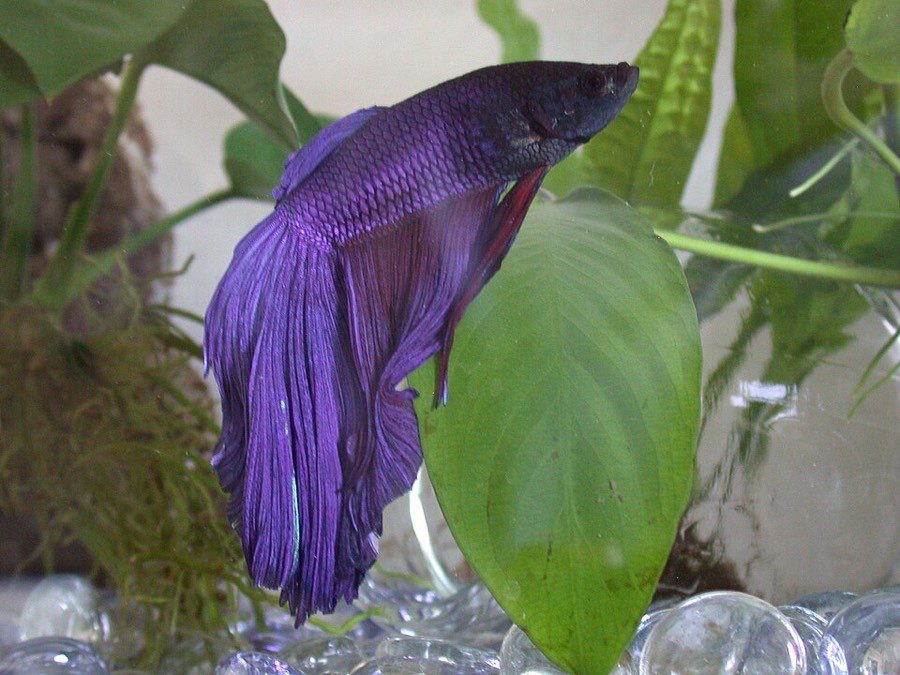
Betta Tail Types
Tail type is the axis most people mean by "betta types". The categories below are the ones you will actually encounter, ordered roughly from the most common in shops to the most specialised.
| Tail type | What it looks like | Notes |
|---|---|---|
| Veiltail (VT) | Long asymmetric caudal that droops downward rather than spreading | The default pet-shop betta. Genetically dominant, cheap, and not shown competitively |
| Delta | Triangular caudal with straight edges, spreading well under 180° | Symmetrical, unlike a veiltail |
| Super Delta | A wider delta, approaching but not reaching 180° | Frequently sold as halfmoon; the difference is the spread |
| Halfmoon (HM) | Caudal spreads a full 180° when flared, forming a clean D shape | The show benchmark. Heavy finnage means more drag |
| Over-Halfmoon (OHM) | Spread beyond 180° | Impressive but can become difficult for the fish to hold up |
| Rosetail / Feathertail | Excessive ray branching giving a ruffled, rose-like edge | ⚠️ Associated with fin collapse and fin biting — see the welfare note below |
| Crowntail (CT) | Webbing between the fin rays is reduced, so rays project as spikes | Distinctive; the exposed rays damage more easily |
| Combtail | A milder version — short spikes along the fin margin only | Often the result of crowntail crossed into other lines |
| Double Tail (DT) | Caudal split into two distinct lobes, with a notably broader dorsal | Often paired with a shorter body; can affect swimming |
| Plakat (PK) | Short-finned, closest to the wild form | Strongest swimmer, least fin damage, commonly mis-sexed as female |
| Halfmoon Plakat (HMPK) | Short finnage with a 180° caudal spread | The current show favourite — halfmoon geometry without the drag |
| Spade Tail | Caudal narrowing to a point, like a spade | Uncommon in shops |
| Round Tail | Fan-shaped caudal with a rounded margin and no straight edges | Similar spread to a delta, different outline |
One more label crosses all of these: dumbo or elephant ear, which describes oversized pectoral fins rather than the tail. It combines with any tail type — a "dumbo halfmoon plakat" is a normal construction — and appears in both sexes, so it says nothing about the fish's sex.
Colours and Patterns
Betta colour comes from stacked pigment and iridescence layers, and the named patterns describe how those layers land on the body and fins.
| Pattern | Description |
|---|---|
| Solid | One uninterrupted colour across body and fins — red, blue, black, or opaque white |
| Bi-colour | Body one colour, fins clearly another |
| Cambodian | Pale, flesh-toned body with strongly coloured fins |
| Butterfly | A band of colour on the inner fin with a pale or clear outer band, divided by a sharp line |
| Marble | Irregular patches of colour that shift and redistribute over the fish's life |
| Koi | A marble-derived pattern of red, black and white patches; galaxy koi adds iridescent speckling |
| Dragon scale | Thick, opaque metallic scaling laid over the body colour |
| Mustard gas | A bi-colour: dark blue or steel body against sharply contrasting yellow-orange fins |
| Copper / metallic | A heavy iridescent layer that shifts colour with the angle of light |
| Piebald | A pale, flesh-coloured face on an otherwise dark body |
| Dalmatian | Distinct spots on the fins over a pale base |
| Wild type | Muted browns and greens with red and blue iridescence — what the species looks like unbred |
Why marble and koi bettas change colour
A marble betta bought deep blue can be half red six months later, and nothing is wrong with it. The marble pattern is understood in the hobby to come from a mobile genetic element that switches pigment expression on and off in patches through the fish's life, which is why marble and koi lines are famously unstable and why a marble is the one betta you cannot photograph once and expect to match forever.
Colour change that is not normal looks different: overall fading with clamped fins, dark horizontal stress stripes, or patches that come with frayed fin edges. Those point at water quality or illness rather than genetics — check parameters first with our water parameter checker.
Size and Body Forms
| Form | Typical adult size | Notes |
|---|---|---|
| Standard B. splendens | Around 70 mm (2.8 in) standard length | The size Seriously Fish gives for the species; ornamental strains sit broadly here |
| "King" betta | Slightly above standard | A retail label rather than a strain — usually a large plakat |
| Giant betta | Up to roughly 10 cm (4 in) | Selectively bred for size. Needs 10 gallons or more and larger portions |
| Short-body / balloon | Standard length, compressed | ⚠️ A deliberately bred spinal deformity; associated with swim bladder problems |
Giant bettas are worth a caveat of their own: they are often sold young, at a size that looks like a finished adult, into tanks that will be too small within months. If you buy one, plan for the adult fish. Our betta tank size calculator covers the volumes.
Short-body or balloon bettas are the one form we would recommend against buying outright. The compact shape is a shortened, compressed spine, and the swim bladder problems that follow are a consequence of the body plan rather than something husbandry can fix.
Wild Betta Species
The genus Betta contains more than 70 described species, and a handful appear regularly in the hobby. These are not colour variants — they are different fish with different water requirements, temperaments and breeding strategies.
| Species | Size / temperature | Breeding | Notes |
|---|---|---|---|
| B. splendens Siamese fighting fish | 70 mm SL · 72–86°F | Bubble nester | The ancestor of every ornamental betta; pH 6.0–8.0, 1–15 dGH |
| B. imbellis Crescent / peaceful betta | 60 mm SL · 68–82°F | Bubble nester | Less confrontational than splendens, but not a community fish |
| B. smaragdina Emerald betta | 60 mm SL · 72–82°F | Bubble nester | Close relative of splendens; green iridescence over a dark body |
| B. mahachaiensis | 60 mm SL · 72–82°F | Bubble nester | Unusual among bettas in wanting hard, alkaline water — pH 7.0–8.5, 5–20 dGH |
| B. macrostoma Brunei beauty | 100 mm SL · 68–77°F | Paternal mouthbrooder | Wants cool, very soft, acidic water (pH 4.0–6.0). Expensive and advanced |
| B. albimarginata | 30 mm SL · 73–82°F | Paternal mouthbrooder | Tiny blackwater species; orange with white-and-black fin margins |
The split that matters most is bubble nesters versus paternal mouthbrooders. Bubble nesters build a surface raft and the male tends the eggs in it; mouthbrooders carry the eggs and fry in the male's mouth for one to two weeks. That determines the breeding setup entirely, and it tends to track other differences — the mouthbrooders in the table are blackwater fish wanting soft, acidic, often cooler water than a shop betta.
Two practical points for any wild species: use the tightest-fitting lid you can find, because they jump far more readily than ornamental bettas, and do not mix species in one tank. Several of these interbreed, and hybrids muddy the small captive populations that keep wild species available at all.

Does the Type Change the Care?
For domesticated B. splendens, far less than the marketing suggests. Every type needs the same 5-gallon minimum, the same 76–81°F, the same cycled tank and the same high-protein carnivore diet. Colour pattern changes nothing at all. What genuinely varies:
| Type | What changes |
|---|---|
| Halfmoon, over-halfmoon, veiltail | Heavy finnage adds drag. Keep flow gentle, add broad-leaved resting spots near the surface, and remove sharp decor |
| Rosetail / feathertail | All of the above, plus watch for self-inflicted fin biting — a chewed, notched tail rather than a frayed one |
| Crowntail | Exposed fin rays snag easily; silk or live plants only, never plastic |
| Plakat / HMPK | The most robust option — but faster, often bolder, and a better jumper. A tight lid is not optional |
| Dragon scale | Check the eyes periodically for scale overgrowth |
| Giant | 10 gallons or more, and larger food portions |
| Wild species | Soft acidic water for most (alkaline for mahachaiensis), cooler for macrostoma, tight lid, species tank |
The pattern behind that table: the longer and more elaborate the finnage, the more the tank has to be built around the fish's ability to swim. Everything else is cosmetic.
Choosing a Type
- First betta: a plakat or a veiltail. Both are hardy, widely available, and inexpensive enough that you are not gambling a large sum on your first cycled tank.
- Maximum display with minimum fin trouble: a halfmoon plakat — the 180° spread without the drag of a full halfmoon.
- Something unusual: koi and galaxy koi are widely available and genuinely striking, with the caveat that the pattern will move over the fish's life.
- Avoid for a first fish: rosetail and feathertail (fin biting), balloon and short-body (spinal deformity), and any wild species until you have kept a betta through a full year.
Whichever type you pick, the tank matters more than the fish does. Set it up and cycle it before buying — our betta tank setup guide walks through it — and check the sex of a short-finned fish before adding it anywhere, using our male vs female betta guide.
Frequently Asked Questions
How many types of betta fish are there?
The hobby recognises around 13 tail types and a dozen or so colour patterns, which combine freely, plus size forms such as giant and plakat. Separately, the genus Betta contains more than 70 described species — but nearly every betta sold as a pet is one species, Betta splendens.
What is the most common type of betta fish?
The veiltail. Its long, downward-drooping tail is genetically dominant, which makes it the cheapest type to produce and the default betta in general pet shops. It is also the one type not shown competitively.
What is a koi betta?
A marble-derived pattern of red, black and white patches resembling koi carp. Because it comes from the marble gene, a koi betta's pattern keeps shifting through its life — the fish you buy will not look the same in a year. Galaxy koi adds an iridescent speckled layer over the same base.
Do different betta types need different care?
Water parameters, tank size and diet are the same across all Betta splendens types. What changes is flow and decor: heavily finned types such as halfmoons and rosetails need gentler current, more resting spots and nothing sharp, while giants need 10 gallons or more. Wild species are the real exception — they need their own water chemistry and a species tank.
What is the rarest betta type?
Among domesticated bettas, true over-halfmoons and stable show-quality colour lines are the hardest to obtain, because both are difficult to breed consistently. Among wild species, Betta macrostoma is the one most often called rare — it is restricted in range, tightly regulated, and expensive.
Which betta type is best for beginners?
A plakat. Short finnage means the fish swims strongly, tires less, snags less and is far less prone to fin biting than the long-finned types. A standard veiltail is the next-best choice and the most widely available.
Sources and Editorial Method
Species sizes, temperature and water chemistry ranges, and bubble-nester versus mouthbrooder classifications are taken from the species accounts cited below. Tail-type and colour-pattern names are hobby and show-standard conventions, not scientific classification, and the boundaries between adjacent categories are conventions rather than measurements. The welfare notes on rosetail finnage, dragon-scale eye overgrowth and short-body forms reflect widely reported keeper and breeder experience rather than published research, and are labelled as such in the text.
- Seriously Fish — Betta splendens: 70 mm SL, 22–30°C, pH 6.0–8.0, 1–15 dGH, bubble-nesting reproduction.
- Seriously Fish — Betta imbellis and B. smaragdina: 60 mm SL, bubble nesters, soft to neutral water.
- Seriously Fish — Betta mahachaiensis: pH 7.0–8.5 and 5–20 dGH, the alkaline outlier among kept bettas.
- Seriously Fish — Betta macrostoma and B. albimarginata: paternal mouthbrooding, cool and acidic water requirements.