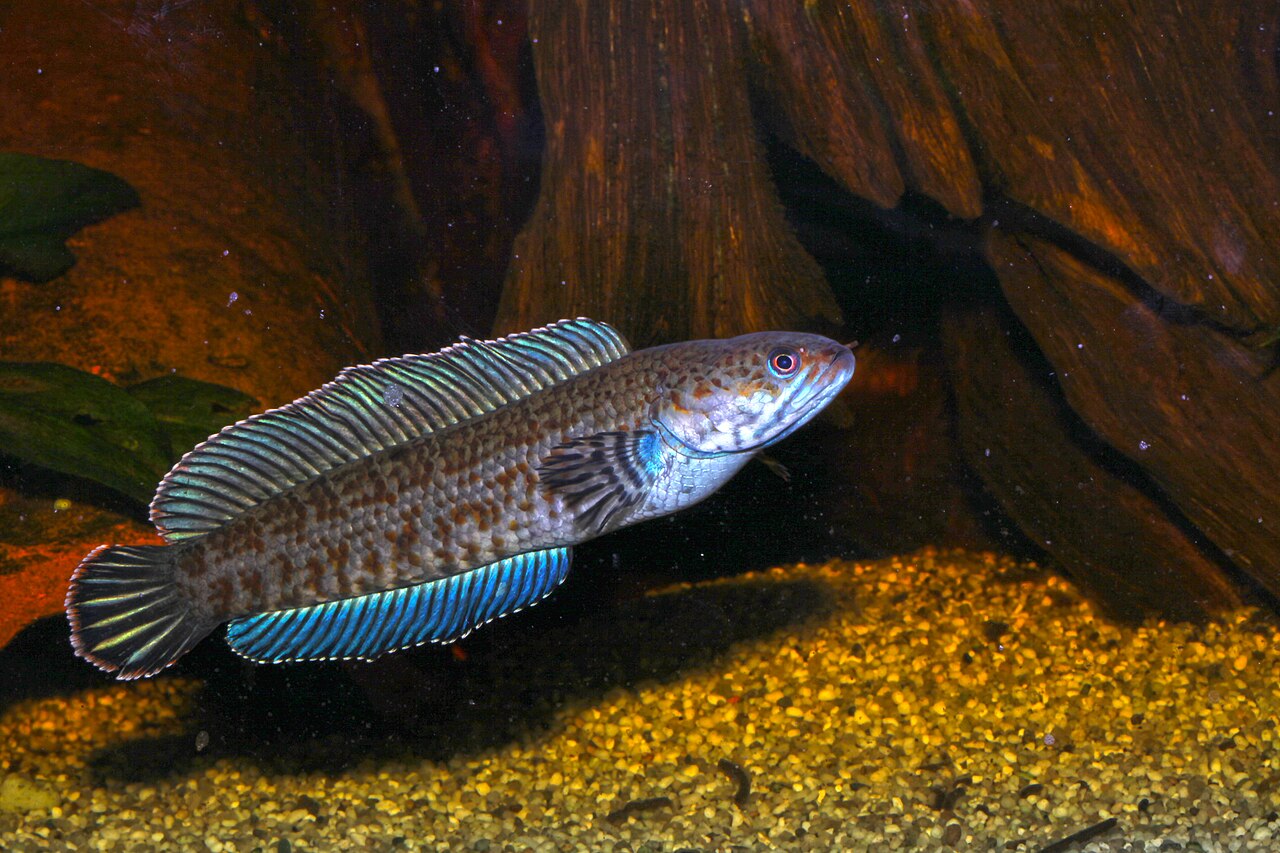
Snakeheads are elongated, air-breathing freshwater predators of the family Channidae, found across Asia and tropical Africa. The name comes from the flattened, heavily scaled head and cylindrical body, which give a resting fish an unmistakably serpentine profile. They are ecologically successful for one reason above all others: a chamber above the gills lets them breathe atmospheric air, so they thrive in stagnant, oxygen-poor swamps, paddy fields and drying pools where other predatory fish cannot survive.
Taxonomy & Classification
Family Channidae sits within the order Anabantiformes, alongside gouramis, bettas and other labyrinth fishes — all groups that independently evolved accessory air-breathing organs. The family contains two living genera:
- Channa Scopoli, 1777 — more than 50 recognised species across South, Southeast and East Asia. Taxonomy remains unsettled, and several widespread names such as C. gachua are now understood to be species complexes that continue to be split.
- Parachanna Teugels & Daget, 1984 — three species in tropical West and Central Africa: P. obscura, P. africana and P. insignis.
Species descriptions have accelerated sharply since 2000, largely driven by ornamental fish collecting in northeastern India and Myanmar. Channa andrao, now the most popular aquarium snakehead, was described only in 2013.
Air-Breathing Anatomy
The defining feature of the family is the suprabranchial chamber, a paired cavity above the gills lined with richly vascularised respiratory epithelium. Air gulped at the surface is held in this chamber, where oxygen diffuses directly into the blood.
Snakeheads are obligate air-breathers, not facultative ones. Adults typically draw 20–50% of their oxygen from air even in well-oxygenated water, and a snakehead prevented from reaching the surface will asphyxiate. This has direct consequences in captivity: a tank must have an air gap between the water and the lid, and that air should be warm and humid rather than a cold draught.
Other notable anatomy: a large terminal mouth with numerous small teeth and enlarged canines on the palate; a long dorsal fin without spines running most of the body length; cycloid scales that extend onto the head in a plate-like pattern; and, in C. asiatica and C. bleheri, complete absence of pelvic fins.
Distribution & Habitat
The native range of Channa extends from Iran and Afghanistan across the Indian subcontinent, through Myanmar, Thailand, Laos, Cambodia, Vietnam, Malaysia and Indonesia, and north into China, Korea and the Amur basin of eastern Russia. That range spans the equator to genuinely temperate rivers that freeze in winter, which is why temperature requirements differ so sharply between species.
Typical habitat is slow or still, shaded, structure-rich water: forest streams, swamps, oxbow lakes, flooded grassland and rice paddy margins. Water is often soft, acidic and stained with tannins, and dissolved oxygen is frequently low — conditions that suit an air-breathing ambush predator and exclude most competitors.
Notable Species
| Species | Common name | Adult size | Native range |
|---|---|---|---|
| C. andrao | Blue / dwarf snakehead | 4–5 in | West Bengal, India |
| C. bleheri | Rainbow snakehead | 6–7 in | Assam, India |
| C. gachua | Dwarf / brown snakehead | 6–8 in | Species complex, Iran to Indonesia |
| C. pulchra | Peacock snakehead | 10–12 in | Myanmar |
| C. asiatica | Chinese snakehead | 12–13 in | Southern China, Taiwan |
| C. aurantimaculata | Golden cobra snakehead | 14–16 in | Assam, India |
| C. marulioides | Emperor snakehead | 24–26 in | Borneo, Sumatra, Malaysia |
| C. striata | Striped snakehead | 24–35 in | South & Southeast Asia |
| C. argus | Northern snakehead | 24–36 in | China, Korea, eastern Russia |
| C. marulius | Bullseye snakehead | 36–48 in | India to Southeast Asia |
| C. micropeltes | Giant / red snakehead | 36–48 in | Southeast Asia |
Full profiles with photographs are on the types of snakehead fish page.
Water Requirements
| Parameter | Range | Notes |
|---|---|---|
| Temperature | 50–82°F (10–28°C) | By species — subtropical species need an annual cool season |
| pH | 6.0–7.5 | Soft, slightly acidic, tannin-stained water is typical |
| Hardness | 2–15 dGH | Tolerant, but dwarf species prefer the softer end |
| Ammonia / nitrite | 0 ppm | Air-breathing masks poor water — damage still accumulates |
| Nitrate | <30 ppm | Above 40 ppm suppresses growth and colour |
| Flow | Low | Native habitat is nearly still water |
| Surface access | Mandatory | 2–4 in humid air gap beneath a sealed lid |
Diet in the Wild
Snakeheads are ambush piscivores that hold position among cover and strike at close range. Stomach content studies across the genus show a diet dominated by fish, supplemented by crustaceans, aquatic insects, amphibians and, in larger species, small reptiles and occasionally birds. Juveniles of most species feed heavily on insect larvae and zooplankton before shifting to fish.
They are not persistent pursuit hunters, and they feed intermittently — a large meal may be followed by several days of inactivity. In captivity this translates to feeding adults only two or three times a week; see the feeding guide.
Reproduction
Channidae display unusually developed parental care, in two distinct forms:
- Paternal mouthbrooding — found in the dwarf gachua-group species including C. andrao, C. bleheri and C. pulchra. The pair spawns in an embrace near the surface, releasing 30–150 buoyant eggs which the male takes into his mouth and incubates for 4–7 days before releasing and guarding the free-swimming fry.
- Nest guarding — found in the large species such as C. striata, C. argus, C. marulius and C. micropeltes. The pair clears a nest among vegetation, releases a floating raft of up to several thousand eggs, and both parents guard the eggs and the resulting fry shoal aggressively, sometimes for months.
This intensive brood care, combined with air-breathing tolerance of poor water, is the main reason introduced populations establish so effectively. Details for aquarium breeding are on the breeding guide.
Invasive Status & Legality
Two species have established reproducing populations in the United States. Channa argus was discovered in a pond in Crofton, Maryland in 2002 and subsequently in the Potomac River, from where it has spread through the Chesapeake drainage and into several other states. Channa marulius is established in canal systems of Broward County, Florida.
In response, the US Fish and Wildlife Service listed all species of Channa and Parachanna as injurious wildlife under the Lacey Act in 2002, prohibiting import and interstate transport. Most US states additionally prohibit possession. Channa argus is separately listed as an Invasive Alien Species of Union Concern in the European Union, with equivalent restrictions in the United Kingdom, and snakeheads are banned nationally in Australia and in several Canadian provinces.
Long-term monitoring of the Potomac population has found the ecological impact less severe than early projections suggested, with native predators such as largemouth bass persisting alongside the introduced snakehead. The precautionary listings nonetheless remain in force. Never release a snakehead into any natural water body; contact your state or national wildlife agency if you need to rehome one.
Frequently Asked Questions
What is a snakehead fish?
Snakeheads are air-breathing freshwater predators in the family Channidae, made up of the Asian genus Channa with more than 50 species and the African genus Parachanna with three. They are named for the flattened, scaled head and elongated body, and range from 4-inch dwarfs to the 4-foot giant snakehead.
Why are snakehead fish able to breathe air?
Snakeheads have a suprabranchial chamber above the gills that acts as a primitive lung, letting them extract oxygen directly from the atmosphere. They are obligate air-breathers, meaning they must surface periodically and will drown if denied access to the surface even in fully oxygenated water.
Where are snakehead fish from?
Channa species are native to South, Southeast and East Asia, from Iran and India through Myanmar, Thailand, Malaysia and Indonesia to China, Korea and eastern Russia. Parachanna species are native to tropical West and Central Africa.
Are snakehead fish invasive?
Two species have established outside their native range in the United States: the northern snakehead (Channa argus) in the Potomac River and surrounding drainages, and the bullseye snakehead (Channa marulius) in southeast Florida. All Channa and Parachanna species are listed as injurious wildlife under the US Lacey Act.
How long do snakehead fish live?
Dwarf species typically live 8-12 years, medium species 10-15 years, and large species such as Channa micropeltes and Channa argus can exceed 20 years in captivity. Wild lifespans are generally shorter because of fishing pressure and predation.
Species and distribution information cross-checked against FishBase and IUCN records; US legal status verified against the US Fish and Wildlife Service injurious wildlife listing.